
A History of Ordinary People in Africa
.
About the project:
A History of Ordinary People in Africa (HOPIA)
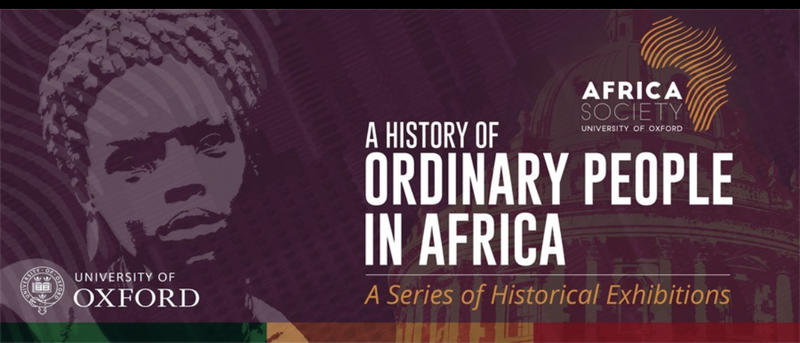
A History of Ordinary People in Africa (HOPIA) is a cultural heritage project consisting of a series of historical exhibitions. It is undertaken by members of the Oxford University Africa Society in partnership with Fusion Arts Oxford and supported by TORCH as part of the Humanities Cultural Programme, and the Oxford African Studies Centre.
HOPIA emphasises the social experience of everyday life and reveals how ordinary people participate in the process of social change. It draws on oral histories, historical artefacts, and photographs to project into the past, centring on women and the underrepresented, and spotlighting their resistance, activism, preservation of traditions, innovations, creativity, and contribution towards positive change.
Our lens of inquiry is Ordinariness
Even as we shift our gaze away from the spires of Oxford to our places of origin, we are interested more in the 'ordinary', under-appreciated people, and unsung heroes than in the stories of conquerors and rulers. Large-scale events are often thought of as a framework within which the lives of common people fit. We want to show that the opposite is also true: we cannot fully comprehend and appreciate the history of Africa, without understanding the histories of our own parents, grandparents, and other ancestors.
Ordinary in this context refers to the less dominant, less visible, and less 'powerful' individuals in society. As such, the use of the term should not be construed as unexceptional or uninteresting. We want to emphasise the social experience of everyday life and reveal the ways in which ordinary people participate in the process of social change.
Our mode of inquiry is Assembly
Assembly, both as a way of operating within history and understanding it, often emerges in the study of Black and African people. Stuart Hall, a Jamaican born British sociologist and cultural theorist, considers assembly as a way to put together elements of history, ‘not as a unity, but in all their contradictory dispersion’. Through assembly, we present the lives of our ancestors as a ‘constitutive element in the fabric of the wider world of ideas, movements, and events’.
This mode of inquiry reflects the fact that ordinariness does not imply isolation; our ancestors lived interconnected lives, which will be brought to life during this series of historical exhibitions. In fact, our use of the term people is not merely to signify a collection of individuals, but a heterogeneous network of genealogies, kinship, friendships, activism, and communication, anchored in a specific geographical region, evolving through time.
Finally, our source material is crowdsourced from the members of the Oxford University Africa Society and other Africans in Oxford, who in turn had to gather family histories from their people on the continent and in the diaspora. Assembly is our object of study, research method, and presentation style.
The project related events:
Identity, Belonging and Change - The exhibition run Saturday 21st and Sunday 22nd October 2023
Exhibition: Identity, Belonging & Change: A Historical Portrait of Everyday Life in Sudan - Saturday 29th - Sunday 30th April 2023
Exhibition: Pathfinders, Enablers & Matriarchs: Untold Histories of Ordinary Women in Postcolonial Ghana - Saturday 28 May, Sunday 29 May 2022
Listen to Family Histories: Curators:
Click here to follow A History of Ordinary People in Africa on SoundCloud
Curators:
- Temitope Ajileye – Former student, Department of Computer Science, University of Oxford.
- Cynthia Kwakyewah – Former student, Faculty of Sociology, University of Oxford.
- David Damtar – Former ORISHA DPhil Scholar who completed his doctoral studies at the Oxford School of Global and Area Studies, University of Oxford
Authors:
- Naa Adjeley Mensah
- Isaac Agyiri Danso
- Thomas Duke Labik Amanquandor
- Emmanuel Mawuli Abalo
- Sylvester Atta Andam

