
Blog Post | Before Munchausen: A Case of Child Murder in Nineteenth Century France
Medical Humanities Research Hub
Before Munchausen: A Case of Child Murder in Nineteenth‑Century France
by Dr Susannah Wilson (University of Warwick)
This post reports on a book discussion, Unquiet Mothers: Violence, Care, and Maternal Ambivalence in 19th-Century France that took place on Friday 6 March 2026 at the Schwarzman Centre for the Humanities.
The event was hosted by the TORCH Medical Humanities Research Hub and chaired by Professor Caroline Warman (Jesus College, Oxford). Dr Susannah Wilson (University of Warwick) spoke about her recently published book, A Most Quiet Murder: Maternity, Affliction, and Violence in Late Nineteenth‑Century France (Cornell University Press, 2025). Professor Katherine Watson (Oxford Brookes University) joined the panel as respondent and discussant.
Susannah’s talk outlined the book’s central premise: an in‑depth investigation of an unusual crime that occurred in Dijon in 1882. On 29 June, a timid five‑year‑old girl, Henriette Barbey, was taken from her school at midday by a local woman. Her body was found the next morning lying at the side of the city canal. What happened in the intervening hours remained unclear throughout the investigation. Eyewitnesses quickly identified the culprit as Marie‑Françoise Fiquet, a 31‑year‑old employee at the local tobacco factory. Approaching the case from a medical humanities perspective, Susannah examined how press reports, police documents, and public opinion transformed a local tragedy into a broader narrative about female deviance, madness, addiction, and class transgression.
Morphine addiction
Medical reports commissioned by the Investigating Magistrate, written by up-and-coming alienist Dr Marandon de Montyel and the famous Parisian physician Dr Émile Blanche, captured a moment when morphine addiction was poorly understood, heavily moralised, and not yet recognised as a disease. Fiquet’s addiction developed as a direct result of medical treatment, reflecting a longer history of iatrogenic harm. Her working‑class status made her dependency seem anomalous, as morphine was widely associated with bourgeois patients. Rather than being interpreted as illness or vulnerability, her drug use was framed as moral weakness, shaping assessments of her criminal responsibility. Morphine was certainly not considered to have produced her violent behaviour.
Factitious disorder and criminal responsibility
The talk highlighted the book’s argument that the Fiquet case may represent an early instance of what is now termed factitious disorder, more commonly known as Munchausen syndrome or Munchausen by proxy. Archival documents show that Fiquet was regarded by her doctors as a skilled “simulator.” She manipulated medical professionals, displayed a persistent fascination with clinical settings, and presented herself as a midwife (apparently attempting to practise both midwifery and abortion without oversight). These behaviours appear to have been rooted in a desire for attention and control, and were possibly the result of her own experience of losing multiple infants. The case raises broader questions about how clinicians historically interpreted suffering, and how gendered expectations shaped perceptions of illness and related behaviours.
The female criminal
The case also fits within a long tradition of depicting violent women as either perverse, masculinised figures or irrational hysterics. Female violence continues to unsettle cultural assumptions about care, motherhood, and moral purity. A microhistorical approach allows this case to be read as both a personal story and a reflection of wider social concerns. Court records and medical reports become, in this context, rare biographical traces of poor and otherwise marginalised individuals. They also prompt reflection on the ethics of reconstructing lives from fragmentary archives, especially lives marked by suffering and stigma.
Conclusions
Dr Marandon de Montyel’s conclusion was that the case remained “shrouded in darkness”, and the motive unknown. This is a powerful reminder that not all human behaviour can be neatly explained by medicine, psychology, or the law. But, not knowing is not a failure of knowledge or understanding, but an admission that we have much to learn about human motivation and actions.
After that talk, Susannah took questions from Professor Katherine Watson and from members of the audience, and the discussion focused on the specificities of the French inquisitorial system and penal code. We discussed the question of criminal responsibility in this case and how it sat with the well-known French concept of the crime passionnel. The murder of Henriette Barbey was not considered within this framework: Marie-Francoise Fiquet was found responsible for her crime, albeit with attenuation of responsibility due to her perceived mental instability, and sentenced to twenty years of hard labour.
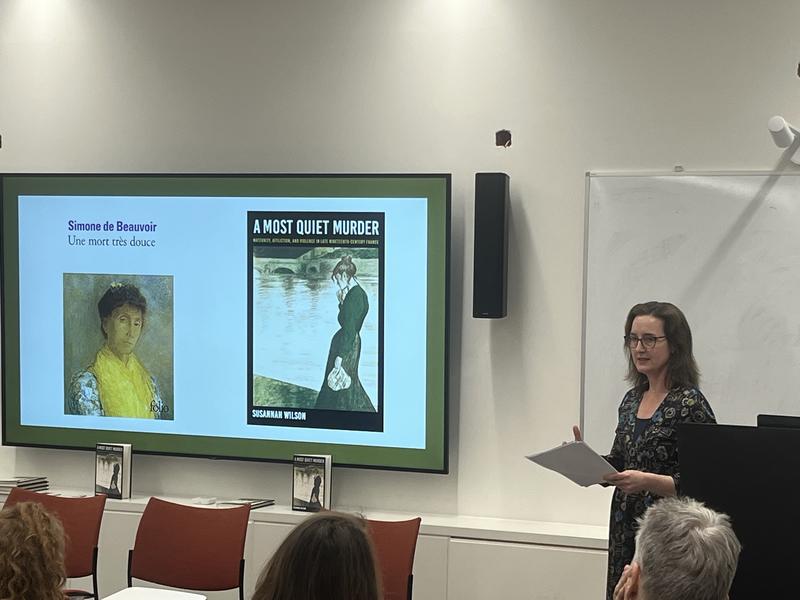
Image by Alberto Giubilini


