Catherine Johns: Hidden Histories, and the Soft Power of Folk Art
Catherine Johns: Hidden Histories, and the Soft Power of Folk Art
Sofia Karliner
Sofia undertook a five-day curatorial research micro-internship in December 2025, hosted by the University of Oxford’s Heritage Partnerships Team and co-supervised by the National Trust.
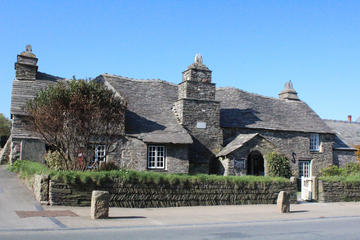
Catherine Johns (born 25 November 1840 in Minster, Isle of Sheppey, Kent) is perhaps best known for her purchase of the Old Post Office in Tintagel and her subsequent donation of the building to the National Trust during the organisation’s first decade. This act played a pivotal role in saving the building from demolition and helped shape the early character of the Trust’s built heritage.
As part of my internship in partnership with the National Trust, I was tasked with piecing together a comprehensive narrative of Catherine Johns’ life. This proved somewhat difficult, as much of her story survives only in fragments: census records, conveyances, newspaper notices, sketches, and the buildings themselves. Yet through these fragments, a powerful narrative emerges—one that challenges conventional ideas about activism, heritage, and authorship. Throughout my week of research, Catherine Johns began to solidify not only as a patron and donor, but also as an artist, a spinster seemingly by choice, and a woman operating within, and perhaps subtly reshaping, the cultural limits of her time.
A Life Shaped by Loss, Culture, and Independence
Catherine’s early life was moulded by a family background that combined long military service, literary connections, and periods of profound personal loss. Her father, Brevet Major Richard Johns of the Royal Marines, maintained a documented friendship with Charles Dickens, situating the family within a wider Victorian artistic and intellectual network. This cultural milieu likely influenced Catherine’s early sensibilities, even as her life was marked by instability and grief.
Following the premature death of her father and several of her siblings, Catherine gradually lost nearly all of her immediate family. By the time she relocated to Tintagel in the mid-1890s, she appears to have been largely alone, unmarried, and recorded in census records as a woman of independent means—a financial position which would have afforded her an unusual degree of autonomy for a woman of her generation.
When Catherine arrived in Tintagel, she began raising funds and advocating for preservation, leading to her purchase of the Old Post Office to prevent its demolition, and eventually its sale to the National Trust at personal cost. These actions appear to sit within a broader anti-tourism impulse closely aligned with the values of the contemporary Arts and Crafts movement, which emphasised vernacular architecture, local life, and resistance to industrial and commercial homogenisation. Needless to say, at a time when the organised protection of historic buildings was still in its infancy, Catherine demonstrated a clear and sustained commitment to conservation.
Art and Community Activism
Yet one of the most intriguing, and least explored, aspects of Catherine Johns’ life is her likely identity as an artist. Emerging evidence suggests that she produced sketches and illustrations of the Old Post Office and its surroundings, and that these images may have played a role in its preservation. Research conducted by a University of Exeter’s Cornwall’s Maritime Churches Project, “Uncovering the Everyday of Tintagel: Identity, Place and the Importance of Landmark” indicates that Catherine may have sold illustrated postcards depicting Tintagel not as a romantic ruin, but as a living village: children at play, domestic scenes, and everyday rural life. If confirmed, this reframes her conservation work as entangled with her own folk or vernacular artistic practice.
This kind of visual production represents a form of soft power: using images to shape how a place is seen and valued at the heart of community. In contrast to commercial tourist photography which depicted Tintagel as a wild natural space ripe for exploration, Johns’ purported illustrations, painted on objects of everyday use and communication, asserted Tintagel as a place worth protecting because people lived there. Johns’ later donation of a second restored building (now known as the Gift House) to the local Women’s Institute further underscores her commitment to community life.
Why Hidden Histories Matter
Catherine Johns’ story speaks directly to the early history of the National Trust itself. Like figures such as Octavia Hill and Beatrix Potter, she operated as a patron and donor at a moment when women’s financial and cultural influence often went unrecorded or under-acknowledged. Furthermore, her domestic partnership with her servant Anne Saunders, whether platonic or otherwise, reflects a form of long-term female companionship that has often been obscured within official records: the two lived together for more than three decades, and contemporary reporting noted that Anne died only three days after Catherine, seemingly of heartbreak, and remembered as her “faithful and attached servant and friend”(Launceston Weekly News, April 4, 1925). Their intertwined lives suggest a relationship of emotional depth and mutual dependence, even if the absence of surviving personal correspondence or testamentary evidence prevents any definitive conclusions.
Her story reminds us that heritage has often been shaped by women working quietly and independently. Recovering lives like Catherine Johns’ allows us to ask deeper questions about how places were saved, the value of art, and whose labour and craft has been written out of heritage histories. In doing so, it invites us to see conservation not only as policy or institution, but as a series of human acts grounded in care, creativity, and conviction.
Sofia Karliner is a first-year DPhil student in Anthropology. Her doctoral research examines the historical construction of colonial categories in late nineteenth- and early twentieth-century anthropology, and their articulation within ethnographic museums, with particular attention to narrative authority and processes of knowledge production. Her internship in partnership with the National Trust has developed her skills in biographical and public archival research and reinforced her commitment to uncovering silences within heritage narratives.
Image Credit: Tintagel Old Post Office, Cornwall © National Trust Images / Rhodri Davies