From page to engagement: research informed poetry workshops at Bolsover Castle
From page to engagement: research informed poetry workshops at Bolsover Castle
As we near the end of the Poetry Heritage and Community: Inspiring Voices project, researcher Abbi Flint reflects on the journey from research to workshops for young people at Bolsover Castle.
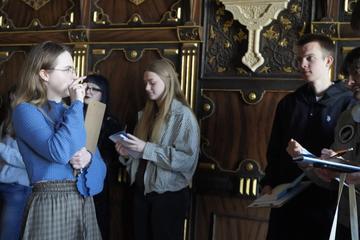
On Wednesday 22 April 2026, poet and Community Engagement Co-ordinator Tyler Turner, led two engaging poetry workshops at Bolsover Castle, for groups of A-Level History students. These were the final in a series of workshops for young people at English Heritage sites across England and informed by the research undertaken over the past 17 months. But how did the conversation between poetry and heritage sites make its way from words on a page to these lively onsite workshops?

Figure 1. Poet Tyler Turner and young people at a poetry workshop at Bolsover Castle © English Heritage.
The journey began with the choice of sites: a collaborative process which drew on the existing poetic associations already known to the project team, where they felt there were opportunities for new poetry to enliven sites, and to reflect the diverse places English Heritage look after. A sample of fifty sites were identified, with three ‘case-studies’ where more in-depth research would be conducted: Bolsover Castle was one of these.
My research into the Castle’s poetic legacy started online, via databases and library catalogues to identify published poems. This built on known connections between Bolsover Castle and the Cavendishes in the seventeenth century, especially the pioneering writing of Margaret Cavendish, but was only part of the picture; what about less formally published poems? The poems of the Cavendishes were the voices of the elite, but we knew Bolsover has a rich industrial heritage and wondered what poetic voices were missing. General web-searches, to find lesser-known and self-published poetry, surfaced a few poems by local writers, a poem by ‘A Derbyshire Peasant’ printed in a local paper in 1820, and an interesting link to the poetry of a local miner Harry Fokinther. Whilst not directly related to the castle itself, this spoke to traditions of working-class writing in the area and reminded me of other research into the literary practices of industrial workers (such as the Piston, Pen & Press project).
It was time to take my research to the physical shelves of libraries and archives: consulting manuscripts and papers in Derbyshire Record Office, and the special collections, local history and local author sections of Bolsover and Chesterfield public libraries. The archives contained several poems within historical guidebooks and manuscripts from the 19th and early 20th centuries, some of which were described as inscribed on the fabric of the building itself. The libraries held further historical guides, and poems by local writers, which had not been picked up in online searches: in collections by past Derbyshire Poet Laureates Helen Mort and River Wolton; and, Edward Boaden Thomas’ epic chorographic poem The Twelve Parts of Derbyshire.
The final part of my fieldwork was a visit to the Castle itself, when the Bolsover Festival of Arts was taking place. This provided the chance to explore the places referred to in the poems – e.g. the Venus statue written about by Sacheverell Sitwell. Tyler told me about the Bolsover Young Writers group run in collaboration with Writing East Midlands and shared poetry pamphlets produced by young people in previous workshops on site. She also told me about the apotropaic marks inscribed on the Little Castle...which I started to think about as a form of poetic mark making.
Back at my desk, I began to make sense of the diverse poetic associations I had collated, and grouped these around three emerging themes:
- The castle as an early site for women’s writing, especially by Margaret Cavendish, but also by William Cavendish’s daughters Elizabeth and Jane.
- Poetry which relates to both the aristocratic history of the castle and the more everyday stories of those who may have worked at the castle and the industrial and working-class history of Bolsover.
- Poetry which was inscribed on the walls and a window of the Castle, and other marks which could be considered through a poetic lens.
Writer, historian and artist JC Niala (Project Co-investigator and Deputy Director & Head of Research Teaching and Collections at the History of Science Museum), took these research themes and example poems and crafted them skilfully into a plan for a workshop that would engage young people and encourage them to create their own poetry. The plan wove in the historical and contemporary context, thinking about relationships between poetry and power, and activities to prompt poems that spoke from different perspectives and recovered hidden voices in the Castle’s past.
The plan was adapted and brought to life by experienced facilitator and poet Tyler Turner who led both workshops, supported by English Heritage colleagues Domi Blackmore and Laura Taylor. For me, it was magical to hear the poems I had located through the research brought to life in situ. For instance, Tyler read out a short poem that was described as written on the glass of the lantern at the top of the Little Castle’s Keep, dated in historical sources to 1840. I couldn’t help but wonder if this was the first time it had been read aloud on-site for almost a hundred years!
Although some of the young people were initially hesitant to engage with poetry, with a number of them writing it was ‘not their cup of tea’ on post-it notes at the start of the session, Tyler’s enthusiasm and inclusive approach meant all of the young people had a go, and one even read their fresh poem aloud. The post-it notes written at the end of the session showed the impact of the workshop and engaging poetically with the history and heritage of the Castle: with one writing it had ‘changed his perception of poetry’.
This is just my view of the journey from page to engagement – I’m sure other members of the team have more to tell – and we plan to share our joint reflections in an article soon. What was at the heart of the process for me was that this was a rich collaborative journey throughout: from the initial discussions to identify sites, conversations with the project lead (Professor Christine Gerrard) and the wider team around emerging themes, JC’s translation of my research themes into a workshop plan, English Heritage colleagues’ relationship building and organisational work in making the workshops happen, the skilful facilitation of Tyler and Domi on the day … and, of course, the energy and openness of the young people who added their voices to the poetic resonances of Bolsover Castle.

Figure 2. Young people attending the poetry workshop at Bolsover Castle © English Heritage.