Music and Medical Humanities | Blog Post
Medical Humanities Blog Post
Music and Medical Humanities
Author: Charlotte Dewarumez (Historian of Art, Université Toulouse-II-Jean-Jaurès)
This blog post is connected to the event, 'Music and the Medical Humanities' which took place on 27 February 2026.
As the first event on music organised by the Medical Humanities Research Hub, this presentation aimed to highlight the relevance of music to conversations about health and healthcare.
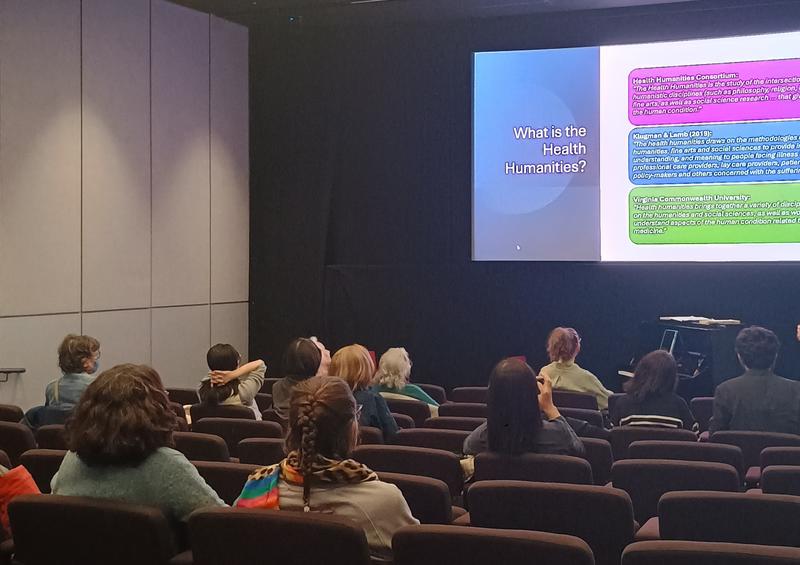
The first speaker, the conductor Peter Shannon, explored the various ways in which music intersects with the medical humanities, offering an overview of the rich interdisciplinary literature on the subject and demonstrating how much there is for the public to discover. He was followed by the musician Hester Crombie, who approached the topic from a deeply personal perspective. She guided the audience through her lived experience of early pregnancy complications and grief, emphasising the role of artistic practice in expressing and navigating difficult emotions. She concluded with a performance of a piece by Schubert, leading us through the different sections of the work and the emotional resonances they conveyed. Although the two speakers had not previously collaborated, their presentations complemented one another remarkably well: the first provided a conceptual framework, while the second offered a powerful illustration of its lived dimensions. Hester Crombie is currently working on a project that aims to make waiting rooms less stressful for women experiencing pregnancy complications, by investigating how sound and music can help reduce distress. More information about the project can be found here.
This event highlighted the importance of music for patients, particularly in reducing anxiety and pain, but also for medical practitioners – a dimension that may be less immediately obvious. Music appears to support practitioners’ mental health while also enhancing their empathy and listening skills. However, there is still much research to be done on both areas. Indeed, emotions are difficult to measure and to reproduce in artificial research settings: should we focus on physiological indicators, such as blood pressure or hormonal markers, or should we prioritise patients’ and practitioners’ own accounts of their experiences? Another challenge lies in the fact that music does not affect everyone in the same way: personal history and cultural background play a significant role in shaping whether a piece of music is associated with positive or negative emotions. Finally, research into doctors’ perceptions of music may be subject to bias, as those who participate in such studies are often musicians themselves.
In any case, recognising the importance of music in healthcare practices would require greater consideration of individual experiences and of the role of sensory inputs in healthcare environments – aspects that are not particularly encouraged within systems that prioritise efficiency and the standardisation of procedures. This discussion brings us back to broader debates about the importance of empathy and compassion in medicine, which have attracted increasing scholarly attention since the affective turn in the humanities and social sciences. Therefore, the topic of music in the medical humanities is well worth further exploration and holds strong potential for future events.