
Reflections on the Body in History Conference
This blog post is an outcome of the Body in History Interdisciplinary PGR and ECR Conference, showcasing research and discussions that emerged from the event.
On Monday 6th July 2026 participants from across the UK and beyond gathered at Oxford’s Schwarzman Centre for the Humanities for the Body in History Interdisciplinary PGR and ECR Conference. The event was organised by the Body in History Network, a TORCH-funded research network which seeks to bring together researchers across disciplines interested in the history, representation, and experience of the human body and its environments.
After opening remarks reflecting on the Network’s aims, the first two panels were ‘The Institutionalised Body’ and ‘The Body in Performance’. In ‘The Institutionalised Body’, speakers addressed how the body has been regulated, recorded, and incarcerated. Sarah J Bremer (Wolverhamptom) explored the tension between economic instrumentalisation and prisoner agency in WW1 prisoner of war camps, Kerri Armstrong (Northumbria) used nineteenth-century parole records to show how the bodies of female prisoners bore witness to the harsh realities of their lives, and Seonaid Anthoney (Independent Researcher) presented on the Metropolitan Police Home and the care of sexually abused girls in early 20th century London. Meanwhile in ‘The Body in Performance’, Linda Kvitkina (Oxford) explored the use of hair and makeup by opera and ballet companies, and performers themselves, in Soviet Kazakhstan, while Anna Mayer’s (Cortauld Institute) timely intervention reflected on an early piece of AI-aided artwork, Barbara T. Smith’s I Am Abandoned (1976), to reveal the ways bodies figure in supposedly disembodied machinic systems. Despite the gap in time and place between the two papers, there were strong connections on the topics of performance, gender and ethnic identity, and the interplay between human agency and technology.
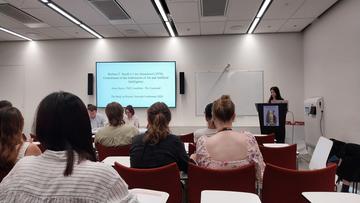
Image credit: Body in History Network
In ‘Representing the Body’, Devon Rosenberger (Oxford) considered how artist Loïs Mailou Jones used portraiture to fashion an image of the modern Afro-diasporic subject, Qiyi Huang (New School for Social Research) shared his research on Maoist propaganda posters, and Hanne Berendse (Innsbruck and Warburg Institute) explained how early modern anatomical fugitive sheets served to reinforce gender hierarchies. ‘Writing the Body and Writing Bodies’ moved from image and performance to the written text, with Elisian Ralli (Oxford) speaking on the feminised materiality of the fin-de-siècle livre de luxe, Yang Zhang (Jinling Institute of Technology) discussing the concept of ‘vegetal femininity’ in women’s fiction, and Finn Manders (UCL and Wellcome Collection) exploring the physical and bodily processes of early modern commonplacing.
Before lunch, we were treated to a keynote lecture by Kierri Price and Elma Brenner, curators from the Wellcome Collection’s ‘Expecting: Birth, Belief, and Protection’ exhibition, which explored beliefs around pregnancy from the medieval world to today. The team discussed the process of putting the exhibition together, the challenges they faced, and the innovative methods they used to bring historical bodies alive to a modern audience. True to theme, the talk had an embodied and tactile element, with Kierri bringing a reproduction of the medieval birthing scroll displayed in the exhibit for attendees to engage with throughout.
The fifth panel on ‘Medicine, Health, and Disability’ brought together two early modernists, Hannah Cotteril (Royal Holloway), discussing her research on female anger in early modern medicine, and Ella Sheddick (UCL and Wellcome Collection), exploring the role of fathers in ‘monstrous birth’ narratives. Toyin Akinkunmi (Independent Researcher) then discussed enslaved people’s experiences of illness, injury, and care in colonial Guyana, offering generative reflections on working with the archive of slavery. Each of these papers engaged with the problem of addressing a well-known archive and subject from a new angle, with a wide-ranging conversation showing the many connections between their interests. Meanwhile ‘The Reproductive Body’ featured Eli Jeannin (QMUL), who delineated the varied representations of female pregnancy in the post-war French Communist press; Maire Hussey (Trinity College Dublin), who explored the changing discourse on family planning in late twentieth-century Ireland; and Angeliki Kokkali (Glasgow), who discussed the post-1974 feminist struggle for reproductive rights in Greece. The panel concluded with Nienke Groskamp (Cambridge), who examined the relationship between reproduction and spiritualism in the Antebellum United States. The presentations highlighted the enduringly contested nature of female reproductive rights, the continuously evolving, and often contradictory, discourses surrounding them, and the importance of historical understanding in informing contemporary debates on reproduction.
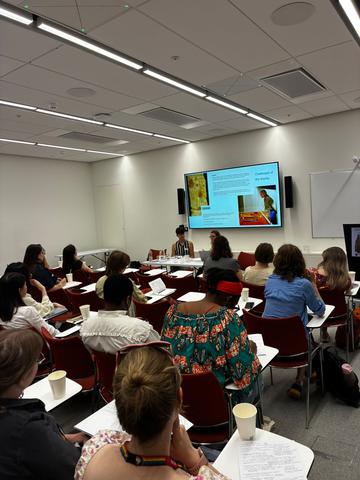
Image credit: Body in History Network
Finally, in ‘Diet and Digestion’, Ailsa Maxwell (Oxford) spoke about the ways in which Georgian people restricted their diets in the face of growing luxury, and Ge Yang (Durham) discussed how new understandings of digestion were formed through the interaction of traditional Chinese medicine and Western physiology in the early twentieth century. Meanwhile, ‘Bodies Politic’ presented papers from Jade Xuan (Durham) on Japanese long-distance running culture and Jonathan McAllister (Cambridge) on the connections between theatre directors and political activists in Interwar Paris.
Across the day, convenors and participants were struck by the many connections and shared interests across discipline, period, region, and approach. In formal and informal conversation, two key observations repeatedly emerged. First, we reflected that while the body is often overlooked or neglected in academic study, it is a topic which most researchers must seek to address in one way or another, and which deserves further attention. As the network convenors noted in the opening remarks, to foreground the study of the body is to deny that knowledge has to be disembodied to be worthwhile. Another takeaway was that there is a keen appetite for sustained critical discussion of positionality, subjectivity, and embodiment in academic practice. How can we work with and through our own embodiment? How can practical, performance, or material approaches, as well as new ways of thinking about archives and academic writing, open up new modes of study? Ultimately, the day-long conference was a rewarding culmination of our work this year, one which fulfilled the Network’s aims to foster collaboration, interdisciplinarity, and innovative thinking about the body in history. It underscored the importance of critically examining bodies within academic scholarship, particularly at a time when bodily rights remain the subject of intense debate and contestation across the globe.
Image credit: Body in History Network
Please let us know any questions to bihn@history.ox.ac.uk
Please follow us on Bluesky @bodyinhistoryox.bsky.social

