
The (Beat) Rover: A View from the Rehearsal Room
Dr Caroline Taylor (English) tells us about the two-week R&D period for research project Restoration Comedy for the 21st Century: Adapting Aphra Behn's Rover.
"There’s going to be a permanent budget line, that’s just like ‘Get some academics in the room’" - (Madelaine Moore, 23 January 2026)
How do you stage a comedy of sexual assault? Can you? Should you? These are a few of the questions that four academics, six creatives, and eight actors asked of themselves during the research and development of a feminist reinterpretation of Aphra Behn’s Restoration comedy, The Rover (1677).
The play is ripe for a revival. The most popular work of England’s first professional female playwright, The Rover follows a group of ‘banished Cavaliers’ who wreak havoc while letting loose at Naples’ Carnival in true Brit abroad fashion. It should be the stuff of a producer’s dreams, offering both the kind of raucous comedy that gets bums on seats and points for social consciousness. However, The Rover is shadowed by its complicated depiction of gender politics and sexual assault. Behn’s rakish hero Willmore seduces and abandons one woman (Angellica Bianca), woos another (Helena), and attempts to rape a third (her sister, Florinda). Florinda is then nearly gang raped by Willmore’s fellow cavaliers; her English lover Belvile does little to protect her. The happy ending sees Florinda marry Belvile, forgive her attackers, and encourage Willmore to marry her sister. Unsurprisingly, the last major UK production closed in 2016.
Restoration drama’s casual attitude to sexual assault poses a problem for scholars of the period. Many of us (not so) quietly campaign for theatre companies to programme more plays from this era. To quote the transatlantic R/18 Collective (an initiative committed to facilitating a revival of Restoration and eighteenth-century drama), ‘the theatrical repertoire from the 1660s to the 1830s provides insights into the deep histories of race, gender, sexuality, ability, nation, and capital that continue to shape anglophone culture and the world’. Indeed, while The Rover may superficially appear incompatible with modern sensibilities, it provokes timely questions regarding both rape culture and the gratuitous sexual violence in contemporary media. Nevertheless, there are practical and ethical problems when staging comedies of sexual assault which can seem irresolvable.
Yet it was exactly these obstacles that female-led theatre company The Thelmas wished to surmount. They were attracted to The Rover for its female authorship, sympathetic portrayal of sex work (Angellica Bianca is a high-class courtesan who delivers the most devastatingly beautiful poetry in the play), and celebration of female sexual desire (Behn’s heroine Helena insists she is as ‘inconstant’ as her lover Willmore). Yet they were perturbed by modern productions’ tendency to downplay the problematic scenes, or (more perversely) play them for comedy. The Thelmas’ production aimed (in director Madelaine Moore’s words) to ‘break the play’. Yet they wished to do so in an intellectually rigorous way, which preserved the spirit of Behn’s work and Restoration drama more broadly.
Thanks to TORCH, The Thelmas were put in contact with a group of Restoration drama scholars based here in Oxford (myself, Professor David Taylor, Professor Ros Ballaster, and Professor Christine Gerrard). We would offer dramaturgical interventions, while also using the R&D process to explore our own research questions regarding how to stage sexual assault in Restoration comedy for twenty-first century audiences. The ensuing two-week workshop was enlightening, challenging, and (most importantly) produced a thought-provoking piece of theatre. And it was even funny!
The (Beat) Rover transposes the action of the play from 1650s Naples to 1950s Soho. Rather than banished Cavaliers, the play’s heroes are wannabe Beatniks recently released from national service. The new setting captured the same sense of generational shift present in Behn’s play, the youth quake and incipient sexual revolution clashing with society’s stubborn misogyny. It also offered an interesting parallel to the Libertine culture which The Rover simultaneously venerates and critiques. The paradox of the Libertine (that to behave naturally is to act recklessly and promiscuously, even if that behaviour does not come naturally) is similar to that of the Beat (one must try very hard to look like one is not trying very hard). The change of setting ultimately served to render an unfamiliar culture more familiar to a modern audience.
Other creative decisions were more challenging. Behn’s original text proved to be unwieldy in this production. Restoration comic dialogue – which prioritises wit over sense – can at times feel esoteric. Moreover, the dramaturgical conventions of the time resist naturalism (which, of course, would not exist until the mid-nineteenth century). This became a particular problem when staging Florinda’s attempted gang rape. During the scene, Blunt (her main aggressor) anticipates classic Bond villains by reciting lengthy monologues explaining his motivation and planned course of action. Blunt’s orations are a dramatic convention familiar to Restoration audiences, and resonate today with incel culture and the manosphere. (Blunt explains that his behaviour to Florinda is part of his general vengeance upon womankind for being dishonest and – crucially – not attracted to him). However, Madelaine was concerned that for modern audiences the speeches would compromise the level of threat in the scene; she found herself asking why Florinda wouldn’t use them as an opportunity to escape?
Yet a brief flirtation with a completely modern rewrite also proved to be jarring. Contemporary parlance suited neither the Beat setting, nor the pantomime performance style of Restoration comedy. The solution was found in a day spent workshopping a selection of scenes with the actors and academics. Scene partners were given a dedicated academic and a Beat slang dictionary. We were then to transpose (rather than translate) their scene into an amalgamation of Behn’s original text, Beat vocabulary, and modern prose. Writer Harriet Madeley used the resulting improvisations to skilfully craft a theatrical lexis that retained the spirit of Behn’s play and Restoration high comedy, while coming across more naturally for both the twentieth-century setting and the twenty-first-century audience.
Perhaps the greatest obstacle was how to handle the play’s ending. As many of the actors pointed out, the sexual assault scenes (while challenging to perform) are made much more unpleasant by the characters’ reactions to the sexual assaults. It seems inconceivable to a modern audience that Florinda would so easily forgive her attackers, and even encourage one to marry her sister. It was this moment that Madelaine was particularly keen to ‘break’. The creatives toyed with a number of metatheatrical interventions that would see the men receive their comeuppance. Yet how to do so in a way which remained thematically (if not textually) coherent proved difficult. Indeed, some options workshopped turned out to be more problematic than the original. One ending – inspired by a scene in the original play where Angellica threatens to shoot Willmore with a pistol – saw the male characters shot as they tried to continue the wedding scene. Without wishing to spoil The (Beat) Rover’s ending before it makes it to stage, the solution was found in Restoration Rehearsal plays (a subgenre of metatheatrical comedies staging plays in rehearsal, that often see the actors rebel against the writer). As an academic, it was satisfying to see that perhaps the answers to some of the problems of staging Restoration comedy lie in Restoration comedy.
Perhaps the most reassuring aspect of the experience was the productive working relationship fostered between the creative and academic teams. Rehearsal rooms do not always facilitate such an easy relationship. It is inevitable that researchers and creatives will not always see eye-to-eye due to differences in our training, processes, and priorities. Unfortunately, it is all too easy for researchers’ respect for the original text to be dismissed as purist, and a production team’s irreverent creative vision to be mistaken for contempt for the play as written. Yet on this project, the teams’ differing skills worked harmoniously to create a piece of contemporary entertainment which remained faithful to the spirit of Behn’s play. Both the production team’s aims and the academics’ research questions were ultimately served well by the collaboration. It was gratifying to hear from actors and creatives how much they had valued our presence in the rehearsal room as facilitators of creativity.
On a personal level, I found the experience revitalising. It is always exciting to see the plays you work on find new life on stage. These are texts which were written to be performed, and they lose impact when confined to the page. But the joy with which the actors approached the project – some of whom had never heard of Behn or Restoration drama before – was a delight to witness. To hear that many now wished to work on more Restoration plays by women writers was invigorating. I hope that a future successful production of The (Beat) Rover will galvanise the theatre industry to stage more of these complicated, compelling, and downright entertaining plays.
Restoration Comedy for the 21st Century: Adapting Aphra Behn's Rover | Performance Research Hub
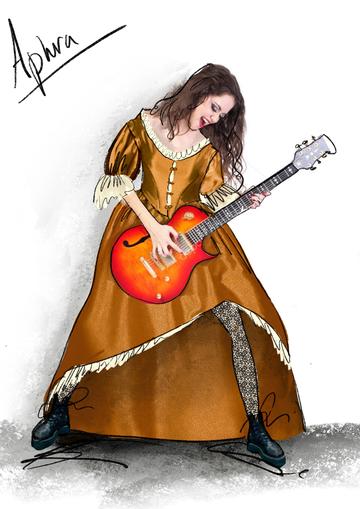
Concept art for The (Beat) Rover, copyright Cory Shipp

