
Blog Post | The History of the Oxford Medical School Gazette
Medical Humanities Research Hub
This year, the Oxford Medical School Gazette returns after a post-COVID hiatus. What is it, why is it important, and why should it continue?
The history of the Oxford Medical School Gazette
Written by Catherine Wang and Mahdi Murtaza, Editors-in-Chief of the Oxford Medical School Gazette
The first edition of the Oxford Medical School Gazette was published in 1949, making it the oldest medical school journal in the world. The Regius Professor of Medicine at the time, Arthur Duncan Gardner, supported the journal from its inception, beginning the long-standing tradition where successors of this prestigious title would each serve as the journal’s named Patron.
In the inaugural edition, Professor Gardner wrote of his great ambition for the Gazette: for its circulation to ‘pass from an unavoidable initial phase of hypotension to a plethora limited only by paper rationing’.
Following this prophetic claim, the publication thrived for decades, platforming current news alongside pioneering research - notably amongst its contributors are Sir Hans Krebs and Sir Peter Medawar, both recipients of the Nobel Prize in Physiology or Medicine. These more scientific articles lived alongside cathartic collections of poetry, satire and personal reflections – unique illuminations of the inner workings of the medical student experience.
The Gazette expanded in readership and continued steadily as a kind of inheritance that was passed down from one cohort of medical students to the next. It doubled as a record for the community, documenting everything from exam scores to engagements, thoughtfully-written obituaries to some (rather scathing) reviews of the annual medical school pantomime, Tingewick (which went through countless spelling changes over the course of the Gazette’s long history – Ptyngewyk remains my personal favourite).
In 2020, as the coronavirus pandemic swept across the world, life as we knew it stopped in its tracks. Medical students were struck by enforced isolation, leaving the traditions of their community to fall by the wayside. The Gazette would lie waiting for several years before its timely revival.
The legacy of the Gazette as a campaign
Recently, I sat down with Professor Terence Ryan, Emeritus Fellow of Green Templeton College and custodian of the collection housed at 13 Norham Gardens – in other words, the keeper of the keys to the enormous archive of every single copy of the Gazette ever published (and longtime contributor, writing dozens of articles in the last 70 years).
Now 93 years old, Professor Ryan still remembers the journal from when he was yet a young medical student at Worcester College. He emphasises to me the prominence of the publication in its early days: that, in 1949, the quality of writing and debate found in the Gazette could not be replicated by any student publication elsewhere in the world.
In particular, he praised the journal’s boldness in spotlighting controversy – showcasing dissident and diffident opinions that would kickstart reform. When the General Medical Council (GMC) and others wrote critiques of the clinical school, the Gazette did not shy away from publishing them. Even beyond the domain of doctors, the influence of the journal’s readership was widely recognised; it was subsequently within the pages of the Gazette that nurses launched a – yet, unsuccessful – campaign for the university to adopt a nursing school, in concert with the increasing specialisation of the role.
Time and time again, the journal has been at the forefront of current debate. It featured a discussion, for instance, analysing the ethics of the 1967 Abortion Act – in 1967. In the same vein, diving into the archives finds a satirical piece parodying a clinical case study to explain the condition of ‘heterosexuality’, branded the ‘commonest of sexual deviations’. While this kind of audacious humour would entertain me even if written today, I note its publication in the 1970s, against the backdrop of pivotal campaigning for LGBT+ rights in Britain.
The Gazette’s legacy lies in its willingness to address crucial issues both within and beyond the medical school. When you place this into the further context that the clinical school at Oxford was established a mere nine years before the journal was first published, you may appreciate how the fabric of the Oxford Medical School Gazette is inextricably interwoven into the history of the medical school.
The Oxford Medical School Gazette survives today – what has changed?
This year, the first edition of the Gazette was published since the pandemic hit. In 2026, our core values remain the same. We want to publish high-quality writing; that which truly deserves the hard-earned attention of its readers.
We are still facilitating transparency between the medical school and its students; still reviewing Tingewick – albeit, in a slightly more gentle manner; and still including articles from the most influential voices in Medicine, with our most recent edition featuring Matt Hancock, Lord Jim O’Neill, Professor Marian Knight and many others.
What has changed, however, is that the Gazette is now more accessible than ever before. In the very first edition published over 70 years ago, the Editors pleaded to readers, ‘buy your own copy and not read someone else’s’. This year, we have been able to print and distribute the journal to all Oxford medical students completely free of charge.
Furthermore, the launch of our website and social media accounts has ensured that the content of the Gazette can be read by anyone at any time, regardless of their background, near or far. As for contributors, we cast the net far and wide to ensure every single corner of our community has a place within our publication; this year, we are proud to feature insights from leading medical researchers, science journalists, economists and politicians. Our sixth form essay competition even offered high school students the opportunity to contribute.
If the Gazette is to endure, it must belong to all of us. Those at Oxford now, those yet to come, and the countless many who have been and gone on. When I reflect on our work done and that ahead, I revisit the words of Professor Gardner written in that first edition from whence this all sprung: ‘May the Oxford Medical School Gazette prosper and endure to instruct ourselves, our children and our children’s children.’
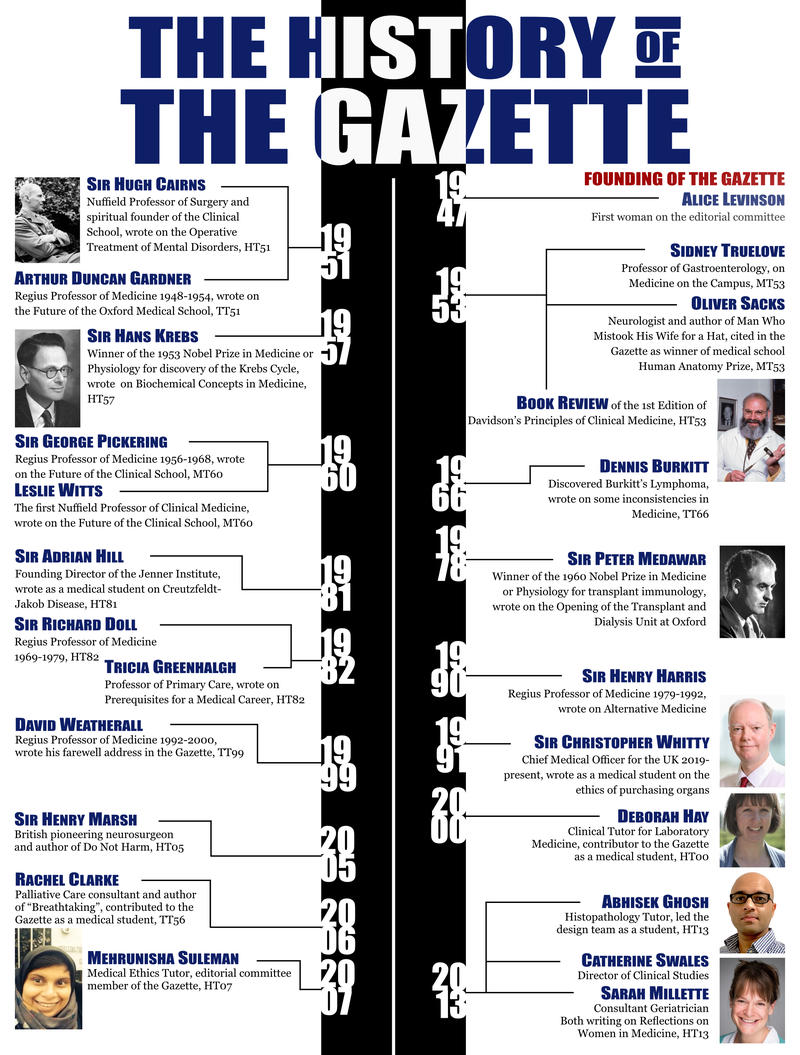
Image Credit: Jiaqi Ding
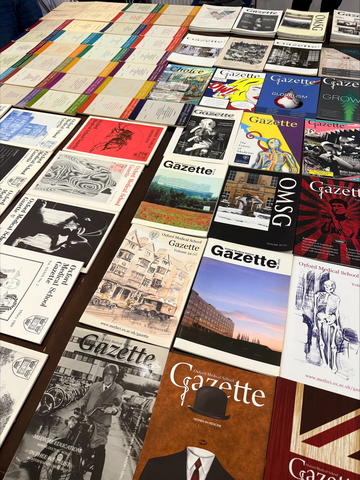
Collection of past Gazettes housed at Norham Gardens

