Rethinking the Environment through Indigenous Creative Practices

Thursday 19 November 2026, 12 midday - 1.30pm
Seminar Room 63, Schwarzman Centre for the Humanities
All welcome
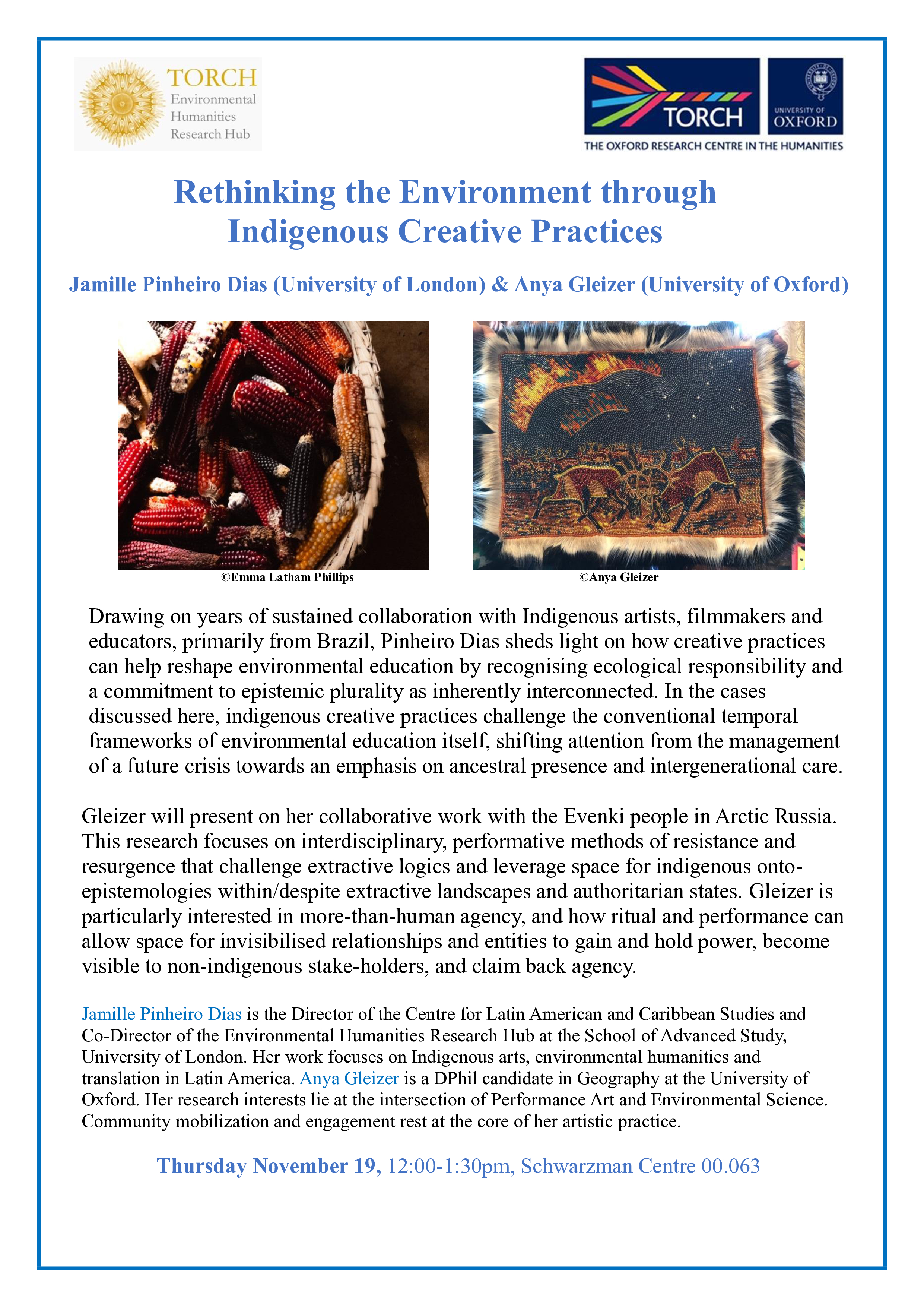
Drawing on years of sustained collaboration with Indigenous artists, filmmakers and educators, primarily from Brazil, Pinheiro Dias sheds light on how creative practices can help reshape environmental education by recognising ecological responsibility and a commitment to epistemic plurality as inherently interconnected. In the cases discussed here, indigenous creative practices challenge the conventional temporal frameworks of environmental education itself, shifting attention from the management of a future crisis towards an emphasis on ancestral presence and intergenerational care.
Gleizer will present on her collaborative work with the Evenki people in Arctic Russia. This research focuses on interdisciplinary, performative methods of resistance and resurgence that challenge extractive logics and leverage space for indigenous onto-epistemologies within/despite extractive landscapes and authoritarian states. Gleizer is particularly interested in more-than-human agency, and how ritual and performance can allow space for invisibilised relationships and entities to gain and hold power, become visible to non-indigenous stake-holders, and claim back agency.
Jamille Pinheiro Dias is the Director of the Centre for Latin American and Caribbean Studies and Co-Director of the Environmental Humanities Research Hub at the School of Advanced Study, University of London. Her work focuses on Indigenous arts, environmental humanities and translation in Latin America. Anya Gleizer is a DPhil candidate in Geography at the University of Oxford. Her research interests lie at the intersection of Performance Art and Environmental Science. Community mobilization and engagement rest at the core of her artistic practice.