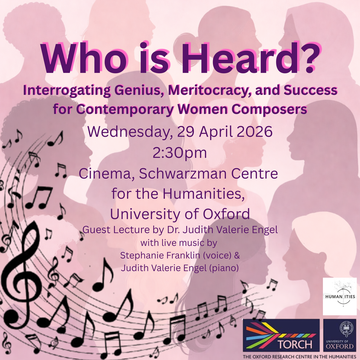
Who Is Heard?
Interrogating Genius, Meritocracy and Success for Contemporary Women Composers Humans in Humanities Network Trinity Term Lecture Speaker: Dr Judith Valerie Engel
With Live Music by Stephanie Franklin & Judith Valerie Engel
Wednesday 29 April 2026, 2.30pm - 3.30pm
Cinema, Schwarzman Centre for the Humanities, Oxford
All welcome
This lecture examines how ideas of ‘genius,’ meritocracy, and success shape—and often constrain—the careers of contemporary women composers. Drawing on research conducted with members of the Association of Canadian Women Composers (ACWC), it explores the structural and cultural challenges faced in the field of composition, from persistent sexism and the legacy of #MeToo, to the internalization of exclusionary beliefs about artistic ‘enoughness.’
Particular attention is given to how age and gender intersect in limiting access to opportunities, including the prevalence of age-restricted competitions and calls for scores that reinforce systemic ageism. The talk interrogates how these frameworks privilege narrow definitions of success while marginalising diverse creative trajectories. At the same time, it highlights how women composers actively redefine and reclaim their identities—reshaping what it means to compose, to succeed, and to be heard on their own terms.
The lecture also features live musical examples by Elinor Dunsmuir, whose career at the turn of the twentieth century offers a compelling case study of historical “modes of dismissal” that have long affected women composers. Her work provides a powerful lens through which to reflect on both continuity and change in the cultural valuation of women’s creative voices.
Biography: Dr Judith Valerie Engel is an Austrian musicologist, concert pianist, and feminist scholar. She holds a DPhil in Historical Musicology from the University of Oxford and is currently pursuing a DMA in Piano Performance at the University of British Columbia, funded through the I2 Lab at the Department of Sociology. At UBC, she is one of the university’s Public Scholars, investigating how professional identities of contemporary Canadian women composers are
shaped by—and intersect with—age, gender, the myth of meritocracy, and the dominant narrative of white male genius in classical music.
The Humans in Humanities Network facilitates interdisciplinary dialogue among humanities researchers on how the human is imagined and represented, recognised and theorised, and engaged and interrogated across the humanities. It creates a reflective space for rethinking what it entails to conduct humanities research in a way that allows people to be seen, heard, and understood.
For enquiries and to join the events mailing list, contact: human-ities@torch.ox.ac.uk
Humans in Humanities Network is part of TORCH Student Networks