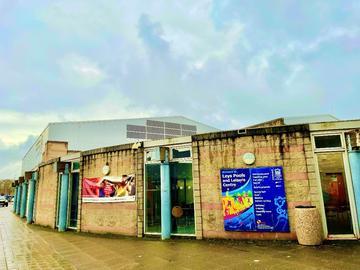
Oxfordshire Community Health and the Humanities at the University of Oxford
Oxfordshire Community Health and the Humanities at the University of Oxford
Improving community health and wellbeing – and evaluating improvements in community health – is easier said than done. After all, it has long been recognized that health is not only the outcome of more extensive health and medical services, but also the result of communities that trust these services, engage with local resources, and adopt healthy behaviours. At the same time, research – and common sense – also demonstrate that changes in trust, engagement, and behaviours can only be achieved from the bottom up, by communities themselves. Measuring such change is difficult: what metrics can capture community change, and how long before such changes filter into health statistics?
Since early 2024, an interdisciplinary team of humanities researchers at the University of Oxford has been working with community organizations and statutory partners to evaluate two novel community health programmes. The two programmes – Community Health Development Officers (CHDO) and Well Together (WT) – aim to reduce health inequalities in the ten Oxfordshire wards identified as priority wards due to being among the most deprived areas in England. While Oxfordshire has, on average, health outcomes that are on par or even slightly better than the national average, this is not the case for all communities. Instead, for these ten priority wards, the 2019 official statistics on health, housing, and income classified them as falling within the 20% most deprived areas in England. The gap in life expectancy between some Oxfordshire wards, for example, can be as much as thirteen years for females and ten years for males.
The interdisciplinary Oxfordshire Health Humanities project provides a framework for collaborative community and academic research, while also rethinking methodologies used to analyse and evaluate health. University researchers conduct fieldwork in ten Oxfordshire wards, and work closely with statutory organisations and community groups. As Well Together is managed by Oxfordshire Community and Voluntary Action (OCVA) and Community First Oxfordshire (CFO), part of the programme’s strength is that it works with established community groups, helping them to empower, fund, and support pre-existing activities, organizations, and resources. Funding for the two programmes comes from the Oxfordshire County Council public health team and the local NHS Integrated Care Board. The programmes and the evaluation project aim to encourage collaboration within local communities as well as between community and academic research. They also strengthen voluntary and community infrastructure through grant programmes, with the overall aim of improving community health in the long term.
The Significance of Community Health
Although most people think of hospitals and the formal structure of the NHS when discussing health, recent government and NHS reports highlight the importance of communities for achieving and maintaining health. The 10 Year Health Plan, published in July 2025, proposes three major shifts to the work of NHS England: the shift from hospital to community, from analogue to digital, and from treatment to prevention. Neighbourhood care and community health are key parts of policy agendas, providing opportunities as well as challenges for health practitioners and researchers, including analysis of their activity and effectiveness.
While medical treatment and evaluations in hospitals have standardised guidelines, these do not always translate to community settings. In contrast to hospital care, community-based care often takes place beyond work hours and via multiple layers, from neighbourhoods to village, township, and county, in local parks and gardens, or in schools and community centres. And although all agree that strong communities are important to health, such features are difficult to measure. The key problem is that community health doesn’t translate easily into the language of numbers and metrics.
At the heart of the Oxfordshire Health Humanities project is a research collaboration that examines the nature and method of community health evaluations. Unlike most health projects, this one focuses on humanities methodologies – bringing together anthropologists and historians, among other researchers. Oxfordshire Health Humanities outlines how health – and particularly community health – depends as much on culture and society as it does on biology. Well Together and the Community Health Development Officers are designed to galvanize – rather than impose – changes in health. Their role is to encourage and support residents to access local health and community resources and aspire to better health. While financial resourcing is certainly necessary, these programmes also try to effect social and cultural change.
More fundamentally, as research has long pointed out, community disengagement is a key obstacle to improving health. Indeed, for communities that face socio-economic difficulties, what often emerges is a history of repetitive but unpredictable cycles of initiatives – a pattern of ‘parachute projects’ that produces detachment, and even distrust. As a project report observes, ‘while policy cycles are usually short, communities have long-term memory.’ By taking a long-term approach to community health that recognizes the importance of trust, social relations, and cultural understandings of health, the Oxfordshire Health Humanities project works with residents and community groups to provide new ways of analysing and evaluating community health.
Community Health in Practice
May Elamin, Community Health Development Officer for Central Oxford, explains:
My work is an incredibly rewarding experience. One of the key initiatives I have helped set up in Central Oxford is the Hinksey Park Community Larder. The larder was launched at the beginning of 2024 and has proven to be a real asset for the community. Yuxin Peng and the Oxford University research team have been a real resource when it comes to insight gathering for the report on our work to Oxfordshire County Council Public Health. But the team's dedication to learning about our work does not end with the report. As the main researcher for Central Oxford, Yuxin plays an important part in fostering working relationships and the promotion of various initiatives, including the larder. Yuxin lent a hand volunteering at the larder and also promoting the larder to the community by attending St Ebb's Primary School with me to inform parents of the resource available to them just a few minutes away. This is a great example of the type of collaboration between the research team and us Community Health Development Officers.
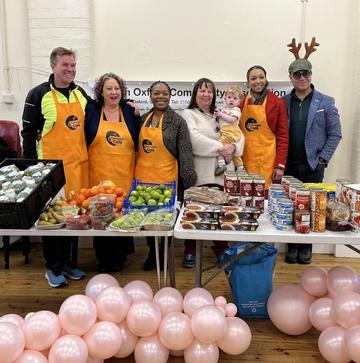
May Elamin, second from right, at the launch of the Hinksey Park larder
Taymur Al-Saadi, one of Well Together’s Oxfordshire Community Capacity Builders, describes his work:
I have the privilege of supporting community organizations and their initiatives aimed at alleviating health inequality. I attend and participate in sessions hosted by community organizations to understand, first-hand, the impact they are trying to achieve. I am also able to have honest conversations about the issues they face, which enables me to assist them and ensure they are better equipped to support the local community and successfully deliver their activities. We have funded a few schools through the programme and we hear their specific challenges around a lack of capacity and resources. They also explain their difficulty in accessing grant schemes whilst recognizing their unique position as hubs offering a much broader range of support for local residents. An example of this is the support provided to Barton Park Primary School. Well Together funds have enabled the school to begin transitioning into its desired role as a local community hub. Barton Park Primary School works in partnership with many different organizations (such as Mothersong and Oxford Parkour) to help bring activities and support to residents of the area.
Working alongside the researchers at the University of Oxford has helped me to gain a better understanding of the overall reach and effectiveness of the Well Together programme. It has been insightful to work with Sally Frampton, as we have conversations and visit local groups together in order to understand their perspective, which in turn informs the research being done by the University team. Her research expertise has helped engage the groups in a new way, ensuring that they feel heard. An example of this is our meeting with Oxford Contemporary Music. Being able to participate in this research has enabled me to understand new perspectives from the groups – such as through their own experience, through questions I may not have thought of asking.
The recent All Well Together event provided an opportunity for participating organizations to engage and celebrate with one another, strengthening our notion of community. Events and networks such as these allow us to visualize that we are all in this together, working with the shared goal of making Oxfordshire a better, safer, and happier place to live. The event also provided further collaboration opportunities. For example, I introduced a specialist provider of parkour activities for children to a representative of the Swahili Community group who was looking for more information on locally available physical activities.

Taymur Al-Saadi (with Stephanie Gonna) at the Blackbird Leys Festival
Sally Frampton, University of Oxford researcher, explains:
Spending time with May and Taymur and following them as they undertake their respective work in communities has changed my perspective on community health in foundational ways. Their activities tangibly connect the methodological work of evaluation with the here-and-now of improving community well-being. I have been struck by the powerful life stories that underlie community health, evident in the motivations of those who run groups, volunteer, and participate, but also – crucially – in the conversations I have had with those who feel less able to engage. More than anything, research on this project has increased my conviction that evaluation should never be reduced to metrics alone, but also requires social and cultural context.
For example, attending the Central Oxford Health and Wellbeing Community Partnership meetings that May leads has been inspiring, providing an opportunity to learn about the range of local activities and initiatives. But it has also been eye-opening in terms of the challenges the area still faces. In particular, social coherence can be difficult where neighbourhoods are separated by shops, tourist attractions, and University buildings.
Breaking down boundaries
At the heart of these programmes and research is the aim to break down boundaries, between organizations, communities, and academic disciplines. As Dan Leveson, Director for Places and Communities for Buckinghamshire, Oxfordshire, and Berkshire West ICB observes, ‘we have spent decades telling people how, where, what, and when to access services; now we are asking communities what will make the biggest difference to their wellbeing.’ Just as statutory bodies such as the NHS and local councils are working with communities and their existing organizations, so too are University of Oxford researchers listening to and working alongside Oxfordshire residents and voluntary organizations – while also providing new interdisciplinary perspectives on how to define, research, and evaluate health for the long term.
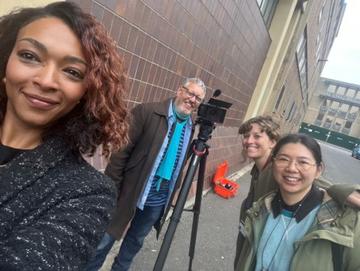
May Elamin, Stuart Hobbs, Sally Frampton, and Yuxin Peng
Taymur Al-Saadi, Erica Charters, May Elamin, Sally Frampton, and Yuxin Peng