
CALL FOR PAPERS | Forecasting the weather, between divination and science
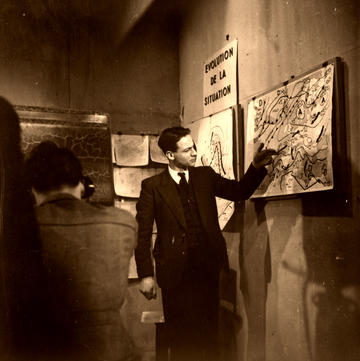
Image credit: First live broadcast on French television of a weather bulletin presented by Paul Douchy, 17 December 1946, © Météo-France
CALL FOR PAPERS
Forecasting the weather, between divination and science
Antiquity to the present
Simon Dolet (Université Savoie Mont Blanc, Chambéry)
Michelle Pfeffer (Calleva Postdoctoral Researcher, University of Oxford)
Date: 9 October 2026
Location: University of Oxford, UK
Submission Deadline: 31 May 2026
It is often said that modern weather forecasting began on 1 August 1861, when Robert FitzRoy, founder and Director of the Meteorological Office, published the first of a long-running series of short-range forecasts in the leading British paper, The Times. It was FitzRoy who formalised the term ‘weather forecast’ to distinguish his new paradigm from what came before. From astrology and arachnomancy to geomancy and extispicy, divining by means of signs and omens had characterised attempts to predict the weather for millennia. By contrast, FitzRoy presented his new method, which made use of scientific tools like barometers and ‘storm glasses’, as a scientific project. The scientific community, however, was not convinced. A mere four years later, criticism of the many failures of his forecasts became so overwhelming that FitzRoy took his own life. A parliamentary report concluded that current atmospheric knowledge was insufficient to forecast the weather scientifically, and the Met Office was ordered to cease daily forecasts.
This poignant episode points to connected issues of expertise, competition, and scepticism that have historically surrounded, and still continue to plague, weather forecasting. Societies have long desired to protect themselves from meteorological and climatic hazards, and throughout history and around the world this has prompted the development of a diverse array of theories and procedures for predicting such ills before they come about. Such variety fuelled fierce debates over the legitimacy of different forms of expertise and fostered competition between alternative predictive theories and methods.
In the past few decades, in the context of the expansion of the history of knowledge and the current environmental crisis, the history of weather forecasting has begun to flourish. Yet most studies begin in the second half of the nineteenth century, with the creation of national meteorological services and the institutionalisation of weather forecasting. For earlier periods, weather forecasting has typically been treated only in brief discussions within broader surveys of historical meteorology, or else in passing in works on the history of astrology.
This conference seeks to break new ground in two key ways: (1) by drawing attention to the broad range of theories and methods of weather prediction across history, beyond those that are more recognisable to modern eyes, and (2) broadening the chronological and geographical focus of forecasting histories to identify shared dynamics, continuities, and transformations.
From ancient ‘weather signs’, lunar interpretation, and astrology to meteorological cycles, synoptic meteorology, and numerical weather prediction, the history of weather forecasting is a story of epistemological rupture corresponding with recurring crises of legitimacy. At different times, and for different reasons, future prediction was taboo and even condemnable, and controversies amongst scholars were intense, with specialists in other forms of prediction sometimes intervening. This conference invites participants to move beyond a strictly intellectual perspective, considering weather forecasting through cultural, economic, environmental, political, and social lenses. Debate over human capacity to predict the weather has been near continuous across history, continuing even today, and this is due not only to the chaotic nature of the atmosphere but also the ever-present spectre of divination and fortune-telling, which have been categorised differently in different times and places.
We are seeking case studies from the ancient world to the present that focus on learned forms of weather prediction (rather than every day or informal beliefs), including but not limited to divination (astrology; extispicy; geomancy; etc); monsoon and seasonal predictions; weather signs; meteorological cycles; synoptic meteorology; and numerical weather prediction.
We ask: how did different bodies of predictive knowledge and practice develop? How was ‘success’ conceptualised and measured, and expertise constructed and contested? How did different practices interact with each other, leading to the success of some and the falling away of others, often with little regard to questions of accuracy? How did it become possible for FitzRoy to distinguish between ‘weather forecasts’ and what he called ‘superstitions’?
We are particularly interested in exploring the fact that many historical practices of divination were far less removed from more ‘scientific’ methods than we might expect, and often relied on standardized bodies of knowledge and theory and extensive observations, record-keeping, and comparative analysis. Indeed, many scientists, even while dismissing ‘superstitious’ divination, were nevertheless drawn to these practices, learning from their approaches and attempting to legitimise them in their own work. There was therefore considerable interaction between divination and the history of scientific forecasting, rather than only competition.
Suggested topics:
- The acceptance of a predictive practice as legitimate is a product not only of its content but also political, religious, and social factors. How does a dominant group maintain its position despite competition? How do unrecognised scholars seek to legitimise their practices? How do religion, political authorities, and experts influence the support for or weakening of such knowledge? How do these dynamics shape the content of forecasts?
- Before the advent of numerical forecasts in the second half of the 20th century, experts in weather forecasting were distinguished by their superior ability to interpret data or signs. Their authority, however, remained fragile in the face of competition and dependence on patronage, as well as competition with other institutionalised forms of knowledge once integrated into national institutions. How does one establish authority in meteorology under such hierarchical constraints?
- From the early modern period, the printing and media circulation of weather forecasts enabled actors to generate income. Various divinatory practices also involved economic stakes, just as contemporary meteorological services sell their data to private actors. To what extent did media exposure and commercialisation create hierarchies among actors and influence the dominance of particular methods?
- The recurrent public criticism of forecasters’ errors, often mocking them and undermining their credibility, together with disputes among authors defending their own methods, weakened the legitimacy of forecasting. Are these dynamics sufficient to provoke a paradigm shift, or do external factors (political, religious, and social) play a more decisive role?
- In their writings, forecasters repeatedly emphasised the utility of their work to promote it to public authorities. Yet across history, public expectations of forecasts have often been very low, due to frequent errors. To what extent were weather forecasts genuinely useful to society before modern predictive methods? Like astrology, might they have served more as a cultural choice or a tool of propaganda than as a practical instrument of governance?
- Contemporary sensitivity to climatic and environmental issues also invites reflection on the ways in which authors of predictions take climate change or the climatic characteristics of a particular location into account. It is also worth asking whether predictions themselves can be interpreted as indicators of environmental awareness or ecological sensitivity.
Submission Process
To submit a proposal, please send an email with the subject ‘Forecasting Abstract Submission’ to simon.dolet-tatre@univ-smb.fr and michelle.pfeffer@history.ox.ac.uk. In an attached word document please include the following:
- Full name as you would like it to appear on the programme
- Email address
- Affiliation, or how you would like to be identified on the programme
- Presentation title and an abstract of no more than 250 words describing your proposed talk and how it fits the conference theme and goals
- An indication of whether you would like to be considered for travel support. (We expect limited funds to be available to defray travel/accommodation costs, with priority given to early career and insecurely employed scholars.)
The submission deadline is 31 May 2026. We plan to circulate a draft program by the end of June 2026. We expect a publication to follow the conference.

