
Witnessing the World Otherwise: Testimony, Community, and the (Post-)Human Conference
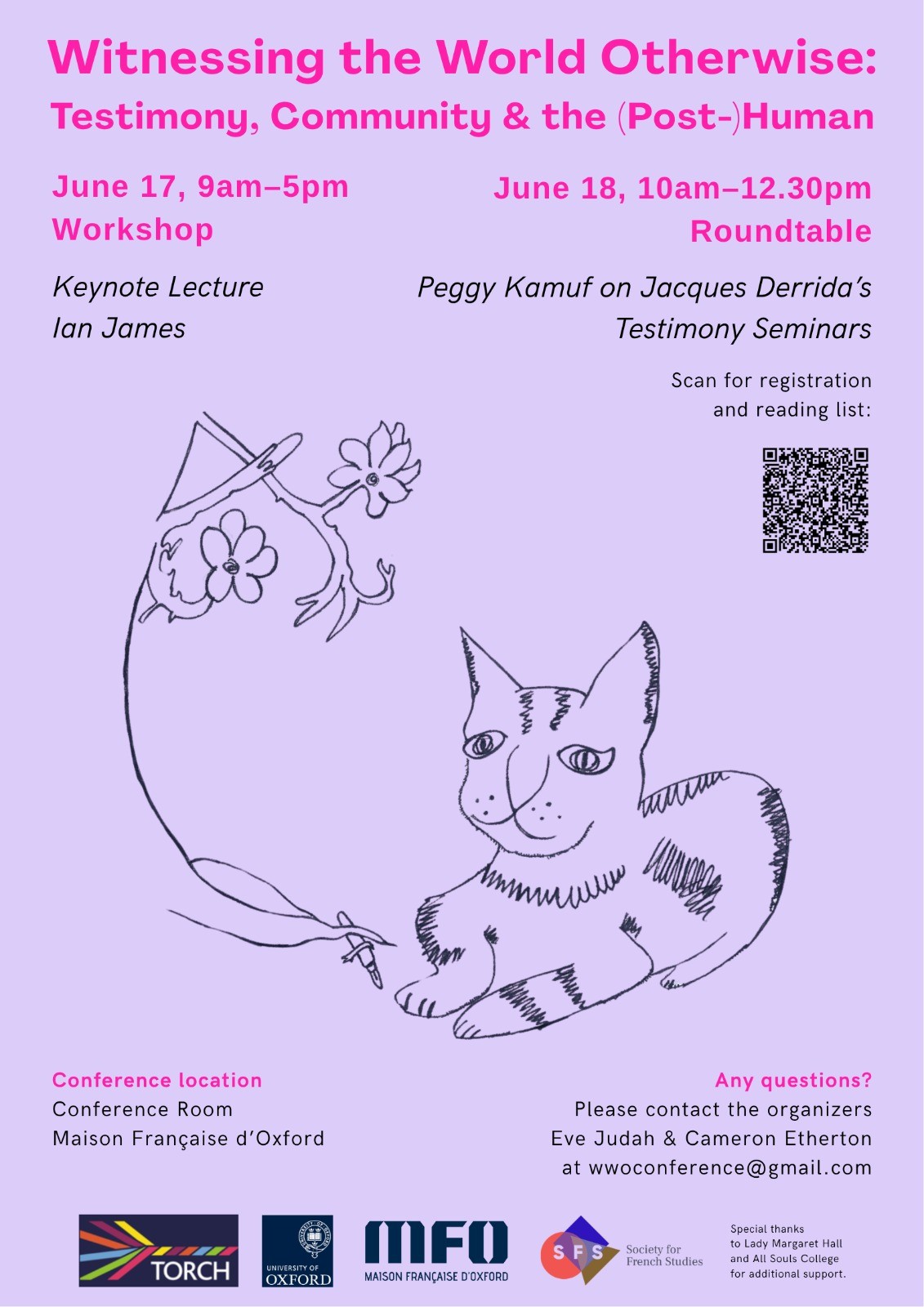
Wednesday 17 June and Tuesday 18 June 2026
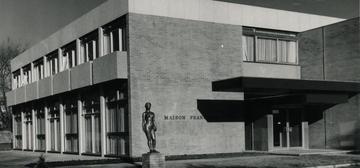
Maison Française d'Oxford
Witnessing the World Otherwise: Testimony, Community, and the (Post-)Human
Conference 17-18 June 2026
Invited Speakers: Peggy Kamuf (University of Southern California) and Ian James (University of Cambridge)
This two-day conference will explore the intersections between testimony, community and the (post-)human. It will focus on a range of responses to these topics: from Holocaust testimony and post-structuralist theory to cutting-edge anthropology and scholarship on the ecological crisis. It will also feature a keynote lecture by Professor Ian James, who works at the intersection of French thought and the sciences, as well as a roundtable with Professor Peggy Kamuf on Jacques Derrida’s testimony seminars.
In the first instance this conference explores a tension in the development of French thought. Thinkers like Sarah Kofman, Maurice Blanchot, Derrida and others were profoundly influenced by the testimonies of Holocaust survivors, such as Primo Levi and Robert Antelme, among others. It was felt that their testimonies bore witness to a limit-experience of the human subject, which was subsequently woven into broader deconstructions of subjectivity as self-presence and identity, as well the possibility of any community based on those metaphysical ideas. Their thinking can be juxtaposed with other tendencies in French thought which seek to disrupt the individual/collective binary by positing the 'transindividual', from Etienne Balibar's readings of Spinoza to Gilbert Simondon's notion of individuation.
And yet, the Holocaust also engenders an implicit and explicit return to 'humanism'. Many of these thinkers formulate questions of an ethical and political nature that cannot be detached absolutely from concerns with the ‘human’ and ‘humanism’, whether in the form of Derrida's reflections on human rights or Kofman's affirmation of a 'nouvel “humanisme”’. How can we interpret such a stress on humanism in many testimonial and theoretical responses to the Holocaust, and the simultaneous philosophical and political impulses toward the deconstruction of the subject by these same authors? As Jewish thinkers, how do they position themselves in relation to the avowed humanist strand of the Colloque des intellectuels juifs de langue française? Is there a way of thinking ‘humanistically’ without a metaphysics of the subject?
This tension is complicated by our contemporary emphasis on the post-human and the non-human. Though these thinkers have shaped our current critical landscape, the non-human, and the environment more broadly, are often (though not always) notable absences in their work. How can we renew the questions they raised around humanism in response to our contemporary conjuncture? This conference will seek to explore how testimony, in both its anthropocentric, legal, literary and philosophical forms, works to reveal the limits and possibilities of community.
We will open a space for considering testimony in a broadened field — where non-human agents (animals, environments, technologies) challenge the boundaries of who or what can testify, and to whom. What kinds of community are possible — or necessary — when the very conditions of life are increasingly ‘dehumanising’, but also when the traditional figure of the human subject is itself under question? Can an individual testify for many? How do changing technologies mediate how we witness the climate crisis? What's the relationship between dehumanisation and the post-human, especially in racialised and/or colonial contexts? Can the earth and/or animals testify (e.g. in the context of environmental personhood)?
Ultimately, this workshop seeks to promote an interdisciplinary engagement with philosophy, at the intersection of the environmental humanities, Holocaust studies, postcolonial and indigenous studies, etc. At its heart is a contemporary political imperative: to reimagine how we think of ourselves as individuals and how we can bear witness in an era of profound ecological and cultural transformation.
Programme:
June 17th
9:00 - Welcome
9:20 - Introduction
9:30-11:00 - Panel 1: Poetry, Testimony, and Responsibility
11:00-11:15 - Coffee Break
11:15-12:45 - Panel 2: Remaining (Human) after the Holocaust
12:45-14:00 - Lunch
14:00-15:00 - Keynote: Ian James (University of Cambridge), Biocommunity - A Preliminary Outline
15:00-15:30 - Coffee Break
15:30-17:00 - Panel 3: Witnessing (in) the Environment
June 18th
10:00-11:00 - Derrida's Testimony Seminars Roundtable Part 1 (with Peggy Kamuf)
11:00-11:30 - Coffee Break
11:30-12:30 - Derrida's Testimony Seminars Roundtable Part 2 (with Peggy Kamuf)
—-------------—-------------—-------------—---------------------------------
Panel 1: Poetry, Testimony, and Responsibility
Moderator: Georgie Walker (University of Oxford)
Cameron Etherton (University of Oxford), Sur-vivre Ensemble: Testaments and the Limits of Community
Jack Morson (Goldsmiths, University of London), Proprété—testimony: on an allusion by Derrida to Francis Ponge's Le savon
Leyla Gleissner (École Normale Supérieure), Surviving Testimony
Panel 2: Remaining (Human) after the Holocaust
Moderator: Magdalena Blincoe-Deval (University of Oxford)
Eve Judah (University of Cambridge), Kofman's Hands: Humanism, Community & Survival
Blanka Pillár (Independent), “...Here I write this poem as I live” - Communal Testimony and the Reestablished Human in Holocaust Literature
Julian Stuart (University of Toronto), Facing the Infinite Absence: Testimonial Objects in Sarah Kofman’s Rue Ordener, Rue Labat
Panel 3: Witnessing (in) the Environment
Moderator: Orestis Tzirtzilakis (University of Oxford)
Esen Kunt (Nişantaşı Üniversitesi), Cartographic Witnessing and the Wounded Surface of Testimony
Jose Parra Zeltzer (University of Oxford), Representations of Fire as Resistance and Catastrophe in Recent Chilean Cinema
Sam LaVedrine (Independent), The Death of the Last Witness: Derrida’s Double-Binds and AI’s Ecological Paradox
Giustino De Michele (Aix-Marseille Université), Testimony, Secrecy, Survival – of the “Animal-Thing”, according to Deconstruction
This conference is generously funded by the Society for French Studies, The Oxford Research Centre in the Humanities (TORCH) and Lady Margaret Hall, Oxford with the kind collaboration of the Maison Française d’Oxford and All Souls College, Oxford.
Organisers: Eve Judah & Cameron Etherton
Witnessing the World Otherwise Network is part of TORCH Student Networks

