Nobel laureates explore life, imagination and the search for meaning at Oxford
Two Nobel laureates from literature and science came together at Oxford’s Stephen A. Schwarzman Centre for the Humanities for a wide-ranging conversation on life, imagination, curiosity and the search for meaning.
You can see highlights of the event on this short video.
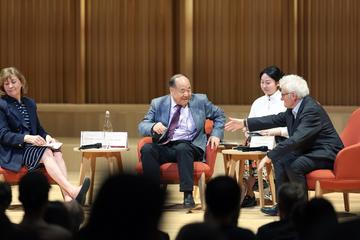
Order and Disorder: Life, Imagination, and the Search for Meaning brought together Mo Yan, the 2012 Nobel Laureate in Literature, and Sir Paul Nurse, the 2001 Nobel Laureate in Physiology or Medicine and President of the Royal Society. The event formed the Annual Lecture of the Mo Yan Interdisciplinary Writing Project, an Oxford Prospects and Global Development Institute initiative supported by The Oxford Research Centre in the Humanities.
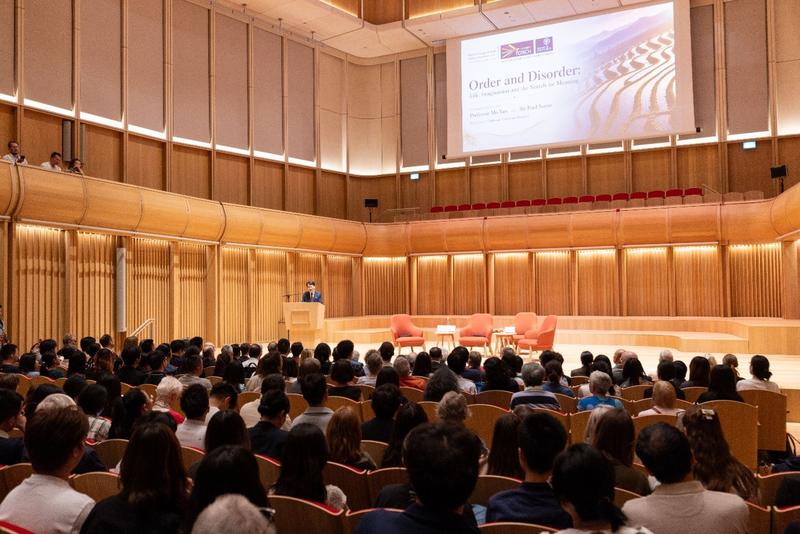
Hosted by Dr Shidong Wang, Director of OPGDI, and moderated by Professor Christine Gerrard, former Director of TORCH and Principal of Lady Margaret Hall, the event was opened by Professor Irene Tracey, Vice-Chancellor of the University of Oxford. Distinguished guests included Professor Sir Roger Penrose, 2020 Nobel Laureate in Physics; Dame Caroline Wilson DCMG, former British Ambassador to China; and Professor Yu Jihong, President of Beijing Normal University.
Dr Shidong Wang, Director of OPGDI, said: ‘Looking at today’s extraordinary scientific transformations, alongside the equally extraordinary global challenges we face, it struck me that we have spent too long treating science and the humanities as separate worlds. In reality, they are different ways of asking the same human questions: how do we understand the world, and how do we understand ourselves within it?’
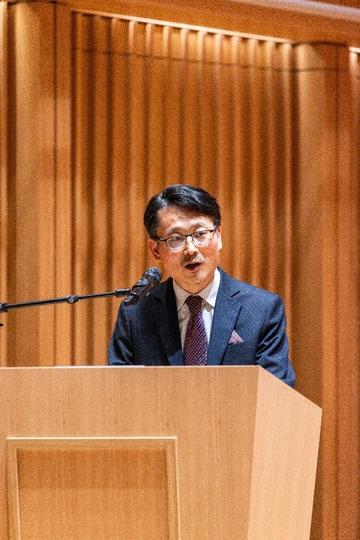
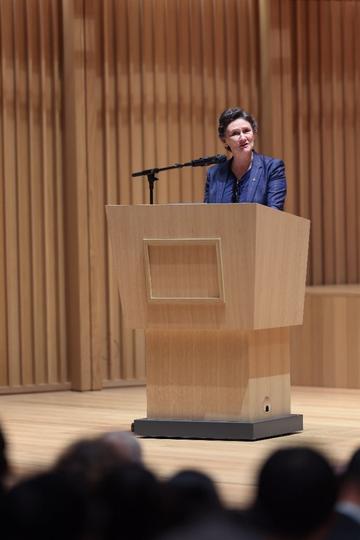
Held in the Sohmen Concert Hall only weeks after the launch of the Schwarzman Centre’s public programme, the occasion reflected the Centre’s ambition to create new spaces for dialogue across the humanities, sciences, arts and wider public life. In her opening remarks, Professor Tracey connected the significance of the new building to the urgency of the event’s theme: ‘Building spaces and creating opportunities for dialogue between the sciences and the humanities, at a time of rapid global change and the rise of artificial intelligence, is more important now than ever. This building is a physical testament to Oxford’s desire to keep humans and the humanities at the epicentre of all things and all subjects.’
Professor Gerrard began by noting that Mo Yan and Sir Paul Nurse might at first appear to stand on different sides of several divides: literature and biology, humanities and science, East and West. Yet the conversation soon revealed a series of shared concerns: curiosity, observation, imagination, humour, and a deep interest in the human condition.
Both speakers traced these concerns back to childhood. Mo Yan recalled growing up in rural Shandong, China, where long days herding cattle were shaped by hardship, solitude and the power of storytelling. Reading gave him strength, while loneliness became a source of literary imagination. Sir Paul, who also looked after cattle in his youth, described how long walks to and from school encouraged him to observe the changing landscape around him, and how watching the stars and planets at night first drew him towards scientific wonder.
Curiosity became one of the central themes of the afternoon. Sir Paul Nurse described scientific research as a sustained desire to know, even when experiments fail or hypotheses prove wrong: ‘Curiosity is essential to nearly all human intellectual endeavour. Because if you are at the borders of knowledge, you will fail very often. Your ideas will be wrong, your hypotheses wrong, and you must ‘have a passion that you want to keep going, to actually keep addressing, ‘Can I solve the problems?’. Mo Yan echoed this through humorous memories of childhood mischief and experiment, showing curiosity as a shared source of both literary and scientific imagination.

A discussion of artificial intelligence returned the speakers to the question of originality. Asked what remains distinctive about human creativity when machines can generate stories and images, Mo Yan said: ‘‘The most precious ability a writer has is originality: to write novels or poems that neither they nor others have written before, and to create distinctive characters who have never appeared in any other literary work. This is the only reason for a writer’s existence; otherwise, their work has no value.’ AI, he suggested, depends on collecting and recombining existing human work; without continuing human creativity, it would have nothing new to learn from". Sir Paul recognised the usefulness of AI as a tool but questioned whether it could truly ask new questions in the way that human imagination can.
Sir Paul Nurse also stressed that: ‘AI regulation cannot be treated as a national issue but requires global cooperation and a renewed willingness to work together across borders.’
Returning to the title of the event, Professor Gerrard asked how literature and science approach order and disorder. Sir Paul described life as an extraordinary form of order emerging from disorder, in which living cells create purposeful structures from the random movement of molecules and atoms. Mo Yan considered disorder from the perspective of fiction: historical and social events may be explained through many causes, he suggested, but the writer’s task is to observe how individual emotions, fates and moral worlds change within them.
Mo Yan said: ‘Wherever there is conflict, there is drama, and from that drama emerge works of art from which humanity can benefit.’
In the final part of the conversation, the speakers returned to life, death, humour and meaning. Sir Paul suggested that while science can help define life, it cannot alone answer the question of life’s meaning. Meaning depends on context, belief, society and individual experience, and therefore requires the humanities, philosophy and theology. Mo Yan reflected on Buddhist ideas of cyclicality and reincarnation, which appear throughout his writing and offer one way of approaching life and death without becoming overly attached to either joy or sorrow.
The conversation ended with laughter. Asked what advice they would give to Oxford students, Sir Paul joked that young people should never listen to advice from their elders. The audience question session that followed showed the enthusiasm of those present to engage directly with both speakers, carrying forward many of the afternoon’s central themes: imagination, nature, education, creativity and the search for meaning.
The event was exceptional not only because it brought together two Nobel laureates in conversation, with a third Nobel laureate in attendance, but because of the kind of exchange it made possible. Literature met biology; Chinese storytelling met British scientific reflection; and questions of childhood, knowledge, mortality and meaning moved freely across disciplinary and cultural borders.
As one of the early public events at the Schwarzman Centre, Order and Disorder offered a powerful example of the Centre’s role as a new space for interdisciplinary exchange at Oxford. It also reflected OPGDI and TORCH’s shared commitment to fostering global engagement, cross-cultural dialogue and conversations that connect the humanities with the wider questions of public life.
At a time when knowledge is often divided into specialisms, the event affirmed the continuing importance of universities as places where difficult questions can be asked together, and where the search for meaning remains a shared human endeavour.