
Jagiellonians: Dynasty, Memory and Identity in Central Europe
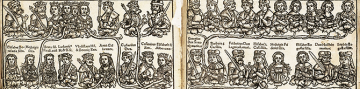
Jagiellonians: Dynasty, Memory and Identity in Central Europe is a major new Oxford research project funded by a European Research Council Starting Grant (2013-18). The Jagiellonians were one of the leading royal dynasties in Renaissance Europe, ruling lands which constitute 14 present-day states. Originating in the medieval Grand Duchy of Lithuania, the Jagiellonians became kings of Poland, Bohemia and Hungary, while Jagiellonian brides became significant figures in the courts of Sweden, Austria and beyond. The dynasty was highly cosmopolitan and international, but has so far been studied overwhelmingly in its local contexts.
The project will, firstly, provide the first study of the Jagiellonians as an international political phenomenon, from the fourteenth century to 1596. It will investigate new, multi-disciplinary ways of writing dynastic history; asking what dynasty was and what it was for. Finally, it will explore the on-going role played by the Jagiellonians in the evolution of national and regional identities in Central Europe, from the late Middle Ages to the present day.
The project aims to offer a meta-history of the Jagiellonians, exploring the meanings attributed to the dynasty over the centuries – by the Jagiellonians themselves, their subjects, successors and subsequent generations.
Click here for the project website.

Contact:
Dr. Natalia Nowakowska
natalia.nowakowska@some.ox.ac.uk

Dynasty and Dynasticism 1400-1700 (March 2016)
We held a conference which aimed to ask afresh what royal dynasty was in the late medieval and early modern periods: what beliefs underpinned it, whence its power and mystique derived, and who or what ruling dynasties believed themselves to be. It seeks to put dynasty under the spotlight, as a category of analysis in its own right, and as a major organising political principle in the pre-modern world.
Rulers and Saints (13 May 2016)
A workshop to understand how rulers build their family identity and take for granted that the sanctity of the holy patrons they chose is something well-defined, stable, and always available to use.
Session 1: Rulers and Saints in Late Antiquity
- Marta Tycner (‘Cult of Saints’): Constantine the Great and the cult of saints at the very beginnings of Christian monarchy
- Paweł Nowakowski (‘Cult of Saints’): Epigraphic manifestations of an early dynastic discourse. Anicia Juliana, Justinian, and the building inscriptions of the churches of St. Polyeuktos and Sts. Sergios and Bakchos in Constantinople
- Nikoloz Aleksidze (‘Cult of Saints’): Parthian in Form, Roman in Essence: Legitimising kingship in the late antique Caucasus
Session 2: Rulers and Saints in the Early Middle Ages
- Marta Szada (Warsaw University): Holy Queens and Their Children. Sanctity and Dynastic Policies in Merovingian Gaul
- Grzegorz Pac (Warsaw University): Limits of royal female sanctity in the Early Middle Ages
- Steffen Hope (Odense): A dynasty of saints? The minor saints of medieval Norway and their association with Saint Olaf
Keynote Lecture:
- Gábor Klaniczay (Central European University, Budapest): 'Beata stirps' revisited. The use of the concept of dynastic sainthood by the Angevins and the Luxemburgs in the 14th century
Session 3: Rulers and Saints in the Late Middle Ages – Jagiellonian dynasty
- Stanislava Kuzmová (‘Jagiellonians’): The failed saints of the Jagiellonians? King Wladislaus of Poland and Hungary and contemporary ideas of dynastic sainthood
- Giedrė Mickūnaitė (‘Jagiellonians’): Dynasty at the gates of paradise: Casimir is the name, Jagiellonian is the password
Renaissance Royal Weddings & Cultural Production (April 2018)
A 3 day conference was held to reconsider cultural output for/about royal weddings which took place between c.1400 and c.1600, as an important source for contemporary thought about monarchy and ruling families/dynasties.
The Polish-Italian Royal Wedding of 1518: Dynasty, Memory & Language
A lecture was held to accompany the Bodleian Library exhibition A Renaissance Royal Wedding, marking the 500th anniversary of the wedding of Bona Sforza and King Sigismund I of Poland.
- Ágnes Máté (MTA, Budapest) ‘The Royal Weddings of Beatrice of Aragon (1474) & Isabella Jagiellon (1539) compared’
- Tomislav Matic (Catholic University of Croatia) ‘The Roles of Croats & Dalmatians in the Wedding of Vladislaus II and Anne de Foix (1502)’
- Patrik Pastrnak (Olomouc) ‘Bona Sforza’s Bridal Journey to Poland as the Imaginary Travelling’
- Marion Rutz (Passau) ‘Demonstrations of loyalty? Four epithalamia on the wedding of Zygmunt I and Barbara Zapolya in 1512’
- Ursula Zachara-Związek (Warsaw) ‘Images of the Jagiellonians & Habsburgs in the occasional literature on Sigismund Augustus’ weddings with Habsburg princesses.’
- Jakub Niedźwiedź (Krakow) ‘The Jagiellonian Epithalamia & New Geographical Knowledge’
- Louise Berglund (Uppsala) ‘The Trousseau of Philippa of England, wife of Eric of Pomerania, 1406’
- Susanna Niiranen (Jyvaskyla) ‘Catherine Jagiellon’s (d.1583) trousseau: the fork as a symbol of Renaissance civilisation in Scandinavia’
- Sylva Dobalova (Prague) ‘Secret and official weddings in the visual memory of Archduke Ferdinand II of Austria (d.1595): Prague & Innsbruck’
- Katarzyna Kosior (Durham) ‘First meetings of early modern royal spouses in France & Poland’
- N. Zeynep Yelçe (Istanbul) ‘A political statement: the wedding festival of Ibrahim Pasha in 1524’
- Felicia M. Else (Gettysburg College) ‘Water-related imagery in Medici Weddings: Dialogues of Art, Cultural Production & Festivals’
- Alex Robinson (ParisSorbonne) ‘Hebe & Hercules conjoined: music and politics in the French celebrations marking the marriage of Maria de’ Medici and Henri IV (1600)’
- Fabian Persson (Linneaus University) ‘Running rings around dynastic hierarchy: tournaments at early modern Swedish royal weddings’
- Giedrė Mickūnaitė (Vilnius) ‘Cultural denial in practice: Helena of Muscovy & Alexander Jagiellon (1495)’
- Marian Coman (Bucharest) ‘A Royal Wedding and a Wife for Heracles Moldavia, 1560s’
- Pavel Kalina (Prague) ‘An eloquent silence: Bohemian Estates and the Wedding of Ladislaus Jagiellon with Anne de Foix in 1502’
Remembering the Jagiellonians: A Book at Lunchtime (October 2018)
Remembering the Jagiellonians is the first study of international memories of the Jagiellonians (1386–1596), one of the most powerful but lesser known royal dynasties of Renaissance Europe. It explores how the Jagiellon family has been remembered across Central, Eastern and Northern Europe since the early modern period. The book considers their ongoing role in modern-day culture and politics and their impact on the development of competing modern national identities
Professor Natalia Nowakowska, the editor was joined by an expert panel.
- Professor Julia Mannherz (Oriel, Oxford)
- Professor Hannah Skoda (St John’s, Oxford)
- Chaired by: Professor Katherine Lebow (Christ Church, Oxford)

