
Stories from the Sands: new fragments of ancient plays
2025-26
About





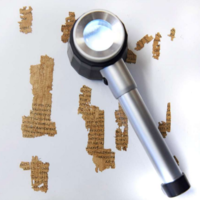
Fragments of papyrus from the Oxyrhynchus Collection, Oxford. Photo by Geraint Lewis reproduced by kind permission of the Egypt Exploration Society
Just thirty-two Greek tragedies survive today. But these thirty-two plays are a tiny fraction of those originally staged in the drama festivals of ancient Athens. For example, seven of Sophocles’ plays survive, out of a total of around 120. The figures are similar for Aeschylus and only slightly better for Euripides, and we have no plays written by the many other playwrights who competed against these ‘big three’ tragedians.
It would be nice to be confident that the plays we have were the best, but the reasons that certain plays survived while others didn’t aren’t always clear. The question of what makes something ‘great drama’ is subjective, and tastes change over time. Ancient texts survived by being copied and recopied over a period of hundreds of years, firstly by ancient scribes onto papyrus rolls, and later in medieval manuscripts, and it only took a small chance or accident to wipe out an entire tradition. All of Aeschylus’ and Sophocles’ plays survive because they were selected as particularly fine or typical examples, though for Euripides we also have ten plays which survived by chance, and which remind us how precarious the entire process was.
But what about the plays that didn’t survive?
Calling them ‘lost tragedies’ is misleading, since fragments of many survive. These fragments may consist of a single word (or even just a few letters), or they may be a run of several lines, or occasionally a chunk of a speech or piece of dialogue.
It’s not uncommon for new texts to surface. Usually, these are found on scraps of papyrus – the remnants of ancient books or scrolls – which were owned by Greek settlers living in Egypt. Sometimes we have ancient plot summaries which means we can roughly reconstruct how the story was told. The fact that these fragments come from plays that weren’t selected for survival means that they have the potential to challenge our assumptions about what Greek tragedy ‘should’ be like.
This project is inspired by the recent discovery of an important papyrus which contains nearly 100 lines from two lost plays of Euripides, Polyidus and Ino.
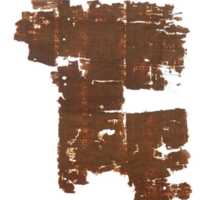
Papyrus on a light box, showing the structure and damage from centuries in the desert. Photo by Geraint Lewis reproduced by kind permission of the Egypt Exploration Society.
Papyrus was the writing material for the Greek and Roman world, used for everything from literature to household accounts or personal letters. The papyrus plant grows in Egypt, and the stalk can be cut into thin strips and woven together into a criss-cross structure which, when dried, becomes flexible and tough.
The majority of papyri have been found on ancient rubbish dumps containing the paper waste of ancient towns. This recent find, however, was excavated from a 3rd century AD grave (showing these plays were still being read hundreds of years after they were originally written). The grave belonged to a mother and child, which is an interesting provocation considering that the texts are both connected to the death of children. One might wonder how and why the papyrus ended up getting there – was this a treasured possession of the dead woman, some kind of moral reflection on the loss of her own child, or just an accident while the grave was being filled?
The text that survives consists of excerpts from two moments in each of the plays – fortunately for us, emotional high points. In both cases, the majority of lines seem to be spoken by the main character (Ino and Polyidus respectively), and so give us an insight into their emotional state and characterisation. It’s disputed whether the excerpts are each a continuous passage, or whether there are excerpts within the excerpt (the latter is probably more likely). If we have excerpts within excerpts, we seem to have different snapshots of one character’s developing response to events within the same broader scene, which itself could offer artistic food for thought.

Close up of a papyrus fragment under magnification. Photo by Geraint Lewis reproduced by kind permission of the Egypt Exploration Society.
Ino and Polyidus are very different types of plays and at first glance have almost nothing in common.
Ino is about female jealousy, infanticide, and vengeance. The protagonist, Ino, has been away worshipping the god Dionysus, and returns to find that her husband, believing Ino has died, has married another woman, Themisto. Ino is disguised as a household slave, and makes herself a confidante to Themisto, who is alarmed by the rumour that Ino has been found. Themisto, a typical evil stepmother, plots to murder Ino’s two sons, but Ino tricks her into killing the wrong children (her own). Meanwhile, however, Ino’s own son is killed by his father in a fit of madness during a hunting expedition, and Ino, in despair, leaps into the sea with her surviving child.
The new fragment comes from the scene where Themisto discovers that she has killed the wrong set of children. We see Ino’s sarcastic and angry gloating over her, as well as her attempt to draw a broader moral.
Polyidus starts with the loss of a child: King Minos’ son Glaucus goes missing and cannot be found. The king calls together a group of seers and prophets, but none are able to help except for the prophet Polyidus, who uses bird lore and omens to discover the child’s corpse inside a storage jar of honey, where he had fallen while trying to retrieve his ball. Minos is devastated and orders Polyidus to bring the child back to life. When Polyidus tells him this cannot be done, he shuts him in the tomb with the child. Polyidus is miraculously visited by snakes and, observing them, he learns the secret of immortality, and is able to bring Glaucus back from the dead. The play not only has a happy ending, but also overturns the normal tragic convention of the finality and seriousness of death, and so makes us reconsider our views on what counts as ‘tragic’.
The new fragment comes from Polyidus’ dispute with Minos as he tries to pressure him to restore his child, and depicts him trying to persuade the king of the finality of death. (The audience will later learn of course, that what he says is not as fixed as we might think).

