2019-20 (ext. -2021) | The White Rose Project
‘The White Rose Project’
Knowledge Exchange Fellow:
Dr Alex Lloyd | Faculty of Medieval and Modern Language | University of Oxford
Partner Organisation:
The White Rose Foundation
In 1943, five students and a professor at the University of Munich were executed for treason. They were members of The White Rose (Die Weiße Rose), a clandestine group which wrote and distributed pamphlets calling on the Germans to resist Hitler.
The White Rose resistance stretched far beyond Munich, but at its heart were six individuals: students Hans Scholl (1918–1943), and Sophie Scholl (1921–1943), who were brother and sister, Christoph Probst (1919–1943), Alexander Schmorell (1917–1943), and Willi Graf (1918–1943), and Professor Kurt Huber (1893–1943).
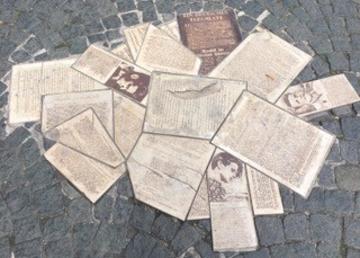
Between 1942 and 1943 the group wrote and disseminated six pamphlets calling on the German people to resist Nazism. They used a second-hand duplicating machine, and despite wartime shortages obtained paper, envelopes, and stamps. They distributed the pamphlets at great personal risk. On 18 February 1943 Hans Scholl and Sophie Scholl took copies of the sixth pamphlet to the University of Munich and deposited them around the atrium at the entrance of the main university building. They were spotted by a university caretaker and detained. Their arrest followed, and on 22 February Hans and Sophie Scholl and Christoph Probst were sentenced to death and executed by guillotine just hours after the conclusion of their trial. Alexander Schmorell, Kurt Huber, and Willi Graf were subsequently arrested, tried, and sentenced to death on 19 April. Schmorell and Huber were executed three months later, on 13 July, and Graf was executed on 12 October 1943.
Much has been written about the White Rose since the first post-war account of their activities was published by one of the Scholl siblings, Inge, in 1952. Their letters and diaries, available in German and in English translation, give a fascinating insight into the lives of these individuals who chose to stand up to the Nazis.
The pamphlets are powerful pieces of writing with hard-hitting slogans such as 'If you know, why don't you act?', 'Sacrifice everything!', and 'Act - prove that you think differently!'. The White Rose is a household name in Germany, but is barely known in the UK.
Working with the Munich-based White Rose Foundation (Weiße Rose Stiftung), the White Rose Project tells the story of the resistance group and its members in the UK, and uses them as an example of a much larger story about the power of the written word, and how culture can inform political action.
http://whiteroseproject.seh.ox.ac.uk/
Traces of the White Rose
Munich, 1942. War rages across Europe. After nearly a decade of Nazi rule, Hitler is at the height of his power. Any form of opposition is unimaginably dangerous. To stand up and speak out would take incredible strength and courage.
Traces of the White Rose is a podcast produced by SANSARA and the White Rose Project telling the story of the White Rose resistance: five students and a professor who stood up to Nazism and paid with their lives. Through newly-translated letters, diaries and resistance pamphlets, hosts Tom Herring and Dr Alexandra Lloyd trace the story of the White Rose resisters in their own words, alongside powerful and moving choral music by English and German composers from SANSARA’s acclaimed album Traces.
Dr Alexandra Lloyd, author of Defying Hitler - The White Rose Pamphlets (Bodleian Library Publishing, 2022), and Fellow by Special Election in German at St Edmund Hall, Oxford, says:
“On 12 October 1943, a 25-year old medical student called Willi Graf was executed by the Nazis. He was one of a group of university students and a professor who together wrote, printed, and circulated anti-Nazi, anti-war pamphlets. All six members of the core resistance group were sentenced to death for this act of defiance against the regime.
2023 marks the 80th anniversary of the White Rose arrests and executions. This is a powerful story which deserves to be better known and which has so much to teach us today.
Traces of the White Rose introduces this courageous group of resisters through their own writings. It’s a truly collaborative effort, with music by SANSARA, and translations by students at the University of Oxford. As a lecturer and author, it’s amazing to hear this story brought to life and to hear traces of these incredible individuals who risked everything for freedom.”
Tom Herring, Artistic Director of SANSARA, says: “A key part of our mission is to give voice to powerful human stories. In this podcast, we hear remarkable voices of resistance recorded in English for the first time, allowing them to inspire and speak directly to a wider audience than ever before.
We’ve learned from Dr Alexandra Lloyd’s work on the White Rose, that music was one of the things that brought the members of the White Rose together and sustained them through dark times. The choral music in the series represents their cultural imagination and embodies their connections to each other: multiple voices working together to express their profound sense of responsibility and their collective demand to be heard.”
The series was made with support from the University of Oxford’s Public Engagement with Research Seed Fund, The Oxford Research Centre in the Humanities, the Higher Education and Innovation Fund, and the Genesis Foundation Kickstart Fund. This collaboration began life as a project supported by the HCP Fund.
LISTEN TO THE PODCAST on Spotify, Apple Podcasts, and University of Oxford Podcasts.
https://podcasts.ox.ac.uk/series/traces-white-rose
SANSARA is an award-winning vocal collective making choral music that matters, giving voice to powerful human stories. Recent projects include a commission from Ukrainian composer Natalia Tsupryk and collaborations with United Strings of Europe, Basel Saleh and Fretwork. Performance highlights include Barbican, St Martin-in-the-Fields, Kings Place, St John’s Smith Square and several leading UK music festivals.
The White Rose Project is a research and engagement initiative at the University of Oxford. It was launched on 12 October 2018 and aims to bring the story of the White Rose resistance group, ‘Die Weiße Rose’, to English-speaking audiences through research, translation, and performance.
2019-20 (ext. -2021) | The White Rose Project
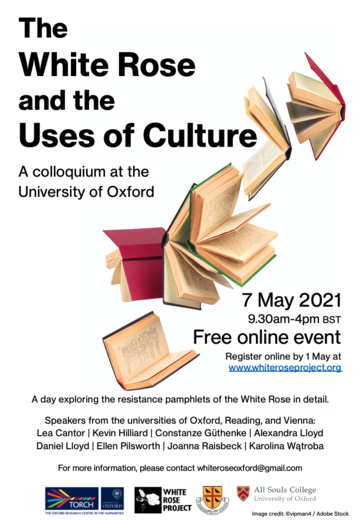
- Welcome and 'The Pamphlets of the White Rose: An Introduction' (Alex Lloyd, Oxford)
- Papers on Goethe (Ellen Pilsworth, Reading) | Schiller & Körner (Kevin Hilliard, Oxford) | Novalis (Joanna Raisbeck, Oxford)
- Papers on Laozi (Lea Cantor, Oxford) | Cicero & Aristotle (Constanze Güthenke, Oxford) | Ecclesiastes & St Augustine (Daniel Lloyd, Vienna)
- Discussion with all presenters on the role of the references in the pamphlets
- 'Culture in Times of Crisis' (Karolina Wątroba)