
Women in Craft

Primary Investigator
Wadham College
Ruskin School of Art
Partner Organisations:
About the project:
Women in Craft is created as a response to the high level of visiting male artists who gave demonstrations and talks about craft in their studio practice. This project offers a culturally diverse perspective about craft through female artists and educators to the university and local schools and encourage young women to become craftsmen. The talk series consists of three visiting artists from different cultural backgrounds and at different stages of their artist/academic careers to talk about their work and what women in craft (traditional and non-traditional) means in their country. The artists will have the chance to include their work (small pieces) in an exhibition. The visiting artists for this project are Alisa Holen (Indiana, USA) who visited in February 2020, Yeliz Ökdem (Kastamonu, Turkey) and Harriet Speed (Oxford, England).
People:
Shawanda Corbett: Shawanda Corbett is currently studying for her doctoral degree in Fine Art at the Ruskin School of Art and Wadham College, University of Oxford.
Website: https://www.shawandacorbett.com/
Visiting artists:
Alisa (Al) Holen will be speaking about women in craft is something that she do enthusiastically and often. Much of the history of ceramics is based on the work of women, and the practically of the work is often at the core of who we are. Her talk will bebased on the persistence of the hand-made object; more specifically, the functional ceramic object. She will explore how these objects are valued, why these objects are made long after they have ceased to be a necessary part of our daily rituals, and why these objects continue to be sought after by both collectors and people with little or no art background.
Yeliz Ökdem (Kastamonu, Turkey)
Yeliz Ökdem is currently exploring ways to express the spiritual essence of the space between life and death afterlife. She has always been interested in nature and animals; however, birds have an intense personal connection to her. Of personal interest is the common childhood hobby of folding paper into abstract and stylised forms. This inspiration for the work comes from traditional origami, a technique she will modify through ceramic sculpture.
Harriet Speed (Oxford, England)
Hattie Speed describes herself as an artist-maker-creative-thinker, as her work encourages others to assert more value on curiosity and play through the objects they use. She has a multi-disciplinary approach, combining her interests in illustration and film with her training as a furniture maker. In 2016 she founded This Girl Makes, an on and offline community of designers and makers with events and DIY kits that celebrate and promote women in craft and design. In her talk, Hattie will describe her experiences as a woman in craft, her motivations for starting the This Girl Makes blog and her most exciting projects to date, including her research project A Maker's Guide to Grief.

‘You’re told that you need two hands to make certain things, but that’s not true at all. It’s just about problem-solving.’ So says Shawanda Corbett as we chat in her studio at the Ruskin School of Art in Oxford, where the Mississippi-born ceramic sculptor and performance artist is currently studying for a doctorate in fine arts. Behind us sits a line of thrown and assembled vessels: tall forms with undulating profiles and playful, painterly designs. ‘To throw on the wheel, it turns out that you actually only need one point of pressure. You can use the wheel’s centrifugal force as the counterbalance.’
Each of these pieces is destined for her first solo exhibition, at Corvi-Mora in London (16 June - 31 July 2020). Bagging a solo show at a gallery of this calibre is an impressive feat for any ceramic artist early in their career, but particularly for one who has had to invent a bespoke throwing technique – Corbett was born with one arm and without legs.
You’re told that you need two hands to make certain things, but that’s not true at all. It’s just about problem-solving
Shawanda Corbett
While studying as a ceramics undergraduate, first at the Mississippi University for Women and then Rochester Institute of Technology, she explored everything from pit- and raku-firing (‘I was worried because my wheelchair is flammable’) through to production throwing, honing her tailor-made skills by churning out quantities of tableware. ‘What really helped was learning about Japanese pottery,’ she reflects. ‘There’s one particular technique where they throw vessels upside down, which means you don’t have to trim the foot. So now all I use to tidy the piece is a rib.’

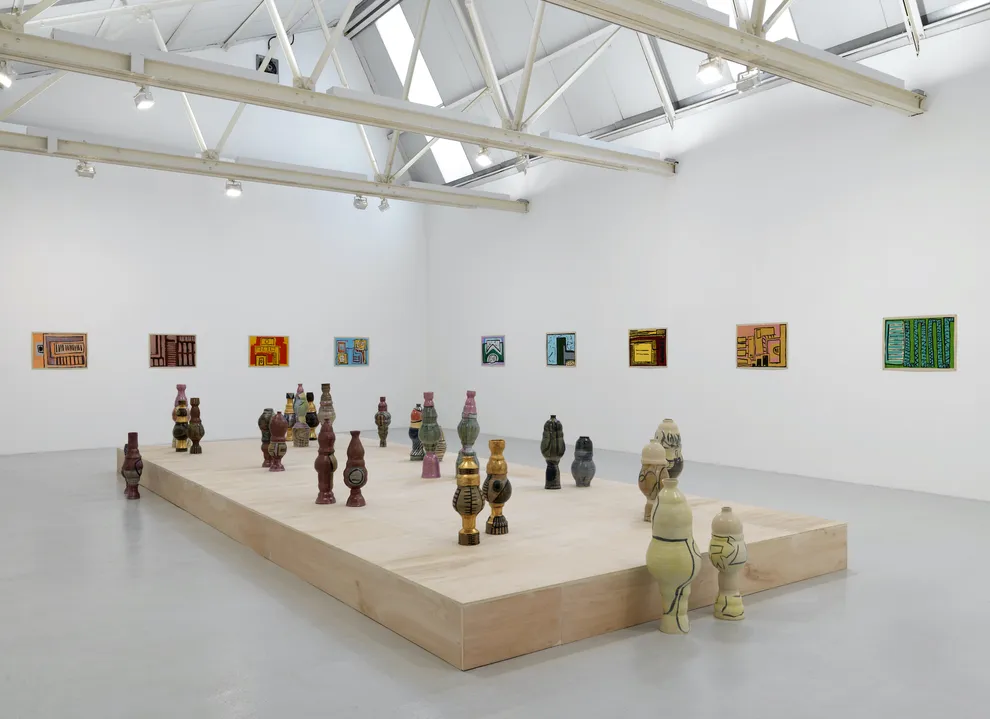
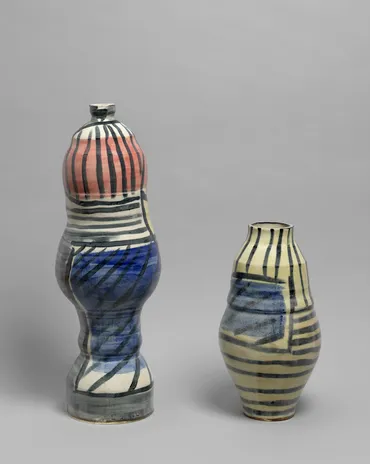
These new sculptural ceramics represent the latest iteration in a long-term project. ‘It’s something that I started about 10 years ago,’ she explains. ‘The vessels are stand-ins for people. They are just like bodies: that’s why there are different shapes, colours and layers to all of them.’ Each is inspired by a real person, remembered from the various neighbourhoods – mostly low-income, predominately home to people of colour – that Corbett has lived in for most of her life in New York and the American South.
Vivid studies on paper line the walls of the studio: paintings waiting to be translated into underglaze on the curved surfaces of her work. They are annotated with titles such as Knee High to a Dragonfly or Basketball Boys. ‘Instead of doing derivative characters, I just want to focus on their personalities or the things that they would say – some kind of catchphrase. I’m interested in the personality of both the neighbourhood and of the people that I grew up around.’
-
Graveyard shift, Shawanda Corbett, 2020, glazed stoneware. Photo: Marcus Leith, courtesy the artist and Corvi-Mora, London

-
I'll tell you what, Shawanda Corbett, 2020, glazed stoneware. Photo: Marcus Leith, courtesy the artist and Corvi-Mora, London

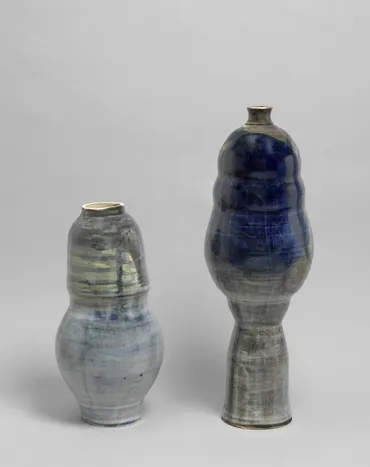
One vessel is inspired by the neighbourhood ‘Candy Lady’, a local woman who sells bargain-priced snacks to children. The only explicit nod to this role is a lollypop-like swirl – all other details are abstracted. ‘I don’t want to make a literal representation. When decorating the pot, I abstract the original painting, so it’s an abstraction of an abstraction.’ Some vessels tilt; others bear subtle quirks, indicative of an individual’s character. ‘I used to plan what these vessels would look like. Three years ago, I watched the Japanese potter Kazuya Ishida give a demo. He saw my forms, then challenged me not to plan any more. Now it’s all more instinctual.’ Corbett credits her time working alongside Ishida on the Oxford Anagama Project – firing traditional Japanese kilns in Wytham Woods – as having given a new energy to her work.
Another figure who helped shape Corbett’s making is Lynette Yiadom-Boakye, the painter whose figurative canvases will be the subject of a solo show at Tate Modern this summer. As Corbett’s MA supervisor, Yiadom-Boakye emboldened her not to give up on ceramics when she was facing burnout. ‘Lynette really encouraged me to stick with it. She also helped with how I see spaces for performances – lighting, colours – with the eye of a painter. Even just seeing how she uses colour in her painting has helped.’

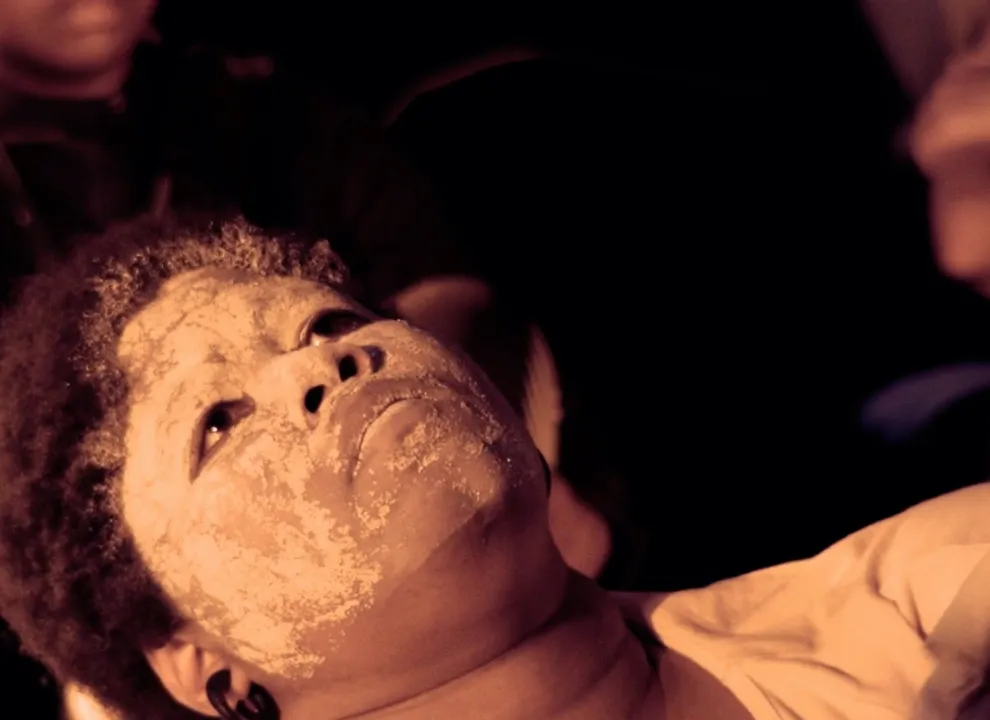
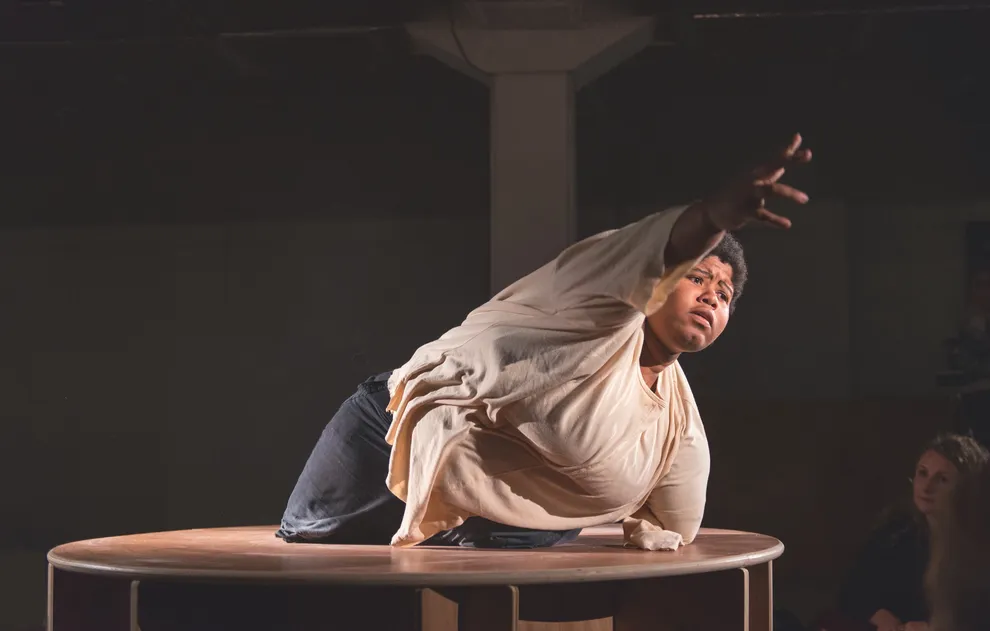
These performances, which combine dance with music, prose and poetry, form the other key strand of her practice. As we speak, she’s plotting a piece to perform at the opening of the Corvi-Mora show, where she will be surrounded by 40-odd vessels. ‘I’m very much influenced by [German choreographer] Pina Bausch’s work. But really, I just love dancing.’ Corbett’s brother, Albert, is a choreographer and dancer, making him an ideal collaborator. ‘Because he is very familiar with how I move, he choreographs some of my work. It can be hard for dancers to break from ideas of body type,’ she reflects. ‘If you don’t have those appendages, how do you envision those movements? Like my ceramics, it’s about finding a non-traditional way of going about it.’
I see being a cyborg as using anything mechanical to enhance one’s life – even just a pottery wheel
Shawanda Corbett
Corbett made a splash last summer with Blackbird in Mississippi, a performance at London’s Serpentine Gallery that saw her dance solo to music by Nina Simone and John Coltrane, adapted for viola and a gospel choir. She wore white porcelain slip daubed dramatically onto her face, which cracked as it dried during the 25 minute-long piece. It’s not hard to see a parallel between her vessels-as-bodies and, in such performances, the idea of the body-as-vessel.
-
Knee high to a grasshopper, Shawanda Corbett, 2020, glazed stoneware. Photo: Marcus Leith, courtesy the artist and Corvi-Mora, London

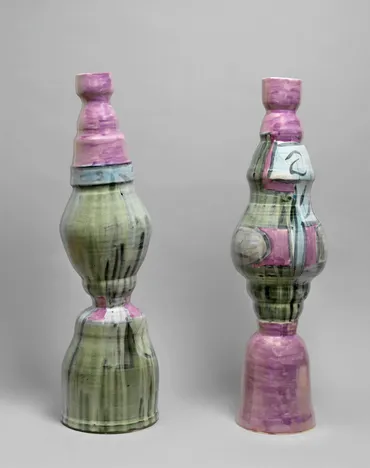
-
Neighbourhood crackhead, Shawanda Corbett, 2020, glazed stoneware. Photo: Marcus Leith, courtesy the artist and Corvi-Mora, London

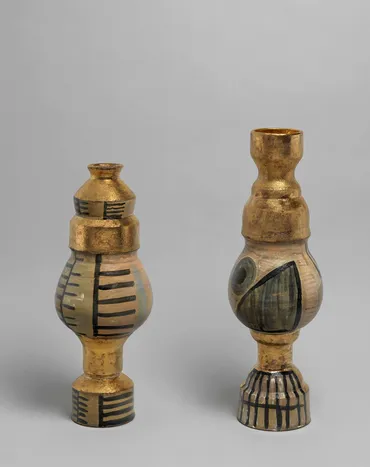
‘I’ve been thinking about the theorist Donna Haraway’s essay ‘A Cyborg Manifesto’ [1985], which explores how mechanical objects relate to human life. It’s pretty outdated, so I’m trying to question and update it from my perspective.’ What does it mean to be a cyborg? For Corbett, it means embracing the fact that, as a physically disabled person, she is reliant on machines to get through each day.
‘I’m taking “cyborg” as a literal term,’ she says. ‘To me it relates to questioning what is “complete”. What is a complete vessel? What is a complete body within performance? I see being a cyborg as using anything mechanical to enhance one’s life – even just a pottery wheel. In the future, I’m thinking of taking this further and using AI to help me push past ideas of both contemporary and traditional ceramics.’
‘Shawanda Corbett: Neighbourhood Garden’ (16 June – 31 July 2020) is at Corvi-Mora, London SE11 4NU
12 June 2020
Please find the full article here.
Also see Shawanda Corbett's Women in Craft project website, part of the TORCH Humanities Cultural Project.
Resources:
(Blackbird in Mississippi) Blackbird in Mississippi

