Blog Post | Autism and Savantism: The Stories We Tell
Humans in Humanities Network
Autism and Savantism: The Stories We Tell
Contributors: Lidija Paradinovic Nagulov, Ella O’Shea, Huishu Wang
With responses from Professor Joseph N. Straus, whom we warmly thank for his talk and generous engagement with these reflections.
Planned and edited by Huishu Wang
The appeal of an oxymoron often extends beyond rhetoric. It has a certain charisma. Two things that cannot possibly go together somehow do, and the contradiction manages to make sense, with a neat little twist. An oxymoron draws us towards a specific way of framing—framing words, concepts, circumstances, and even humans.
Consider autism. The term itself has never quite settled, its meanings and boundaries ever contested. The stereotypes attached to autism, however, seem to have settled in well ahead of the concept itself, courtesy of a convenient oxymoron: the pairing of supposedly incompatible qualities, disability and exceptional ability.
Autism and savantism are intertwined, or so the recent cultural fascination would have it. As Joseph N. Straus (2014) points out, “in the popular imagination and in the literature and film of the period since 1990, the two terms are increasingly conflated: savants are assumed to be autistic; autistic people are generally represented as savants.”
But what underlies this entanglement? What are the stories we tell, and how do they shape the lives of the people caught up in them? What do those whose lives are framed by these narratives have to say about them, and how might their own stories challenge the familiar ones? How might researchers bring ears that listen rather than judge, eyes that see rather than gaze, and minds willing to turn critical scrutiny back on the research itself?
Straus’s critique addresses the medical and cultural narratives through which the “autistic savant” has become familiar. The title of his article (2014) gathers historical labels such as “Idiots Savants” and “Autistic Savants” before eventually arriving at “Autistic People Who Are Good at Things,” a simple but powerful description that breaks with the myth of the savant genius and the othering that accompanies it. It enacts a realistic reappraisal of autistic people as embodied beings whose lives, like everyone’s, are shaped by their bodies and minds and their interactions with the social and cultural surroundings.
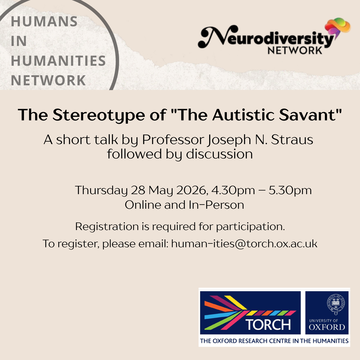
In Trinity Term 2026, the TORCH Neurodiversity Network and the Humans in Humanities Network invited Professor Joseph N. Straus to give a research talk on “The Stereotype of ‘The Autistic Savant.’” The discussion that followed brought together students, researchers, and members of the autistic community to question familiar narratives of autism and the interplay between ability and disability. The reflections collected here grew out of that exchange, bringing diverse experiences and perspectives into conversation with Straus’s research. Responses to a response, then, with questions of their own. Where might we take the story next?
Ella O'Shea: The Whole Landscape of Me
Ella studies English Language and Literature at Mansfield College. Her BA dissertation explores early medieval literature through the lens of neurodiversity theory. Ella is passionate about inclusive and accessible medievalism and co-founded Mearcstapan. For Ella, the antithetical framing of ability and disability in popular understandings of autistic identity is fundamentally problematic:
“The line that struck me most from Straus’ talk was a line from a 60 Minutes documentary on Derek Paravicini, an autistic and blind jazz musician, in which the narrator called him “blessed with an island of extreme talent in a sea of profound disability.” Disability and skill were presented to be as antithetical to each other as water and land. The island metaphor places Paravicini’s musical skills as a metaphorical refuge from the expansive tides of the disability around him. But a refuge for whom?
As an autistic person, I don’t see my strengths and struggles as fractured islands and seas in my personality, but as part of the whole landscape of me. Like all human beings, I have things I am good at and things I am less good at and need support with (even if different from neurotypical). But in a world where ableism associates disability with worthlessness, people are often eager to cling to these islands of skill, seeing them as something that makes disabled life valuable. It feels sometimes like autistic people can only be sob stories, or we can only be exceptional—only sea, only our “islands.” But we are whole landscapes. We are whole people.”
Professor Straus responds:
“Ella makes some great points here. Fundamental to the “savant” label is the idea that a person is bifurcated into two distinct components: the special skill (valued) and all the rest (devalued). As Ella suggests, it is better to take people as complex wholes than as simple parts.”
Huishu Wang: The Gap and The Bridge
While Ella questions the opposition between ability and disability, Huishu (DPhil in Music) asks how the judgements sustaining that opposition are formed: Might an apparent demonstration of incapacity also reveal a gap in communication and understanding? Huishu’s research on music and disability studies continually reminds her that norms not only regulate bodies and minds but also regulate what is seen and acknowledged:
“The documentary announces a “shocking” contrast between Derek Paravicini at and away from the piano. When interviewer Lesley Stahl asks him to “hold up three fingers,” Derek replies, “I can do that,” extending both hands with all fingers spread out. When she repeats the request, he attempts to hold three fingers of one hand with the fingers of the other, before saying, “I don’t know how to do it.” He then accepts her offer of help, and she folds his thumb and little finger into his palm, leaving three fingers extended. The narration then supplies the metaphor Ella questions: “an island of extreme talent in a sea of profound disability.” The same hands are presented as evidence of extraordinary ability at the keyboard and profound disability away from it.
But what does “hold up” mean here? Which three fingers? What counts as completing the task? Derek’s movements could be read as an attempt to further clarify what response is expected, and his acceptance of help as participation in that process. When he says, “I don’t know how to do it,” precisely what he does not know is unclear. How to interpret the instruction? How to produce the gesture? Or perhaps both?
Straus (2014) describes how observers who fail to recognise autistic expressions of emotional involvement may come to doubt whether the musician has an inner life at all. Interpretative difficulty may become a judgement of deficiency. Similarly, the documentary turns an unresolved moment into evidence of Derek’s general incapacity. Ironically, it may be Derek who is bridging the communication gap, while the documentary seems too busy assigning incapacity to him to notice that possibility.”
Professor Straus responds:
“Huishu centres the question of communication. Autism is considered (among other things) as a communication disorder. The person with autism is understood to have difficulties in communication or to communicate in unusual, abnormal ways. The autist is the problem. Huishu suggests that communication is a two-way street and that, if there is a problem in communication it might be understood to reside in the non-autistic person or, better, in the interaction itself. In the relationship between Stahl and Paravicini, the viewer is presumed to see Paravicini as the problem. Huishu properly suggests a more realistic and nuanced way of thinking about the situation.”
Lidija Paradinovic Nagulov: Schrödinger’s Autist
Lidija extends the discussion to the power of labelling: who gets to define autistic abilities and support needs, and why does recognising one so often mean discounting the other? Growing up where only the most visibly disabling forms of neurodivergence were recognised, Lidija began recognising neurodivergence in herself and her family following her son’s autism diagnosis. She now researches neurodivergence through the medical humanities, asking how society views, self-understanding, and visibility shape neurodivergent people’s relationships with the world:
“The White Horse Dialogue by Gongsun Long posits that a white horse is not a horse. At first glance absurd, it actually reveals an odd truth about the labels we attach to things—a “white horse” is not a horse. A “woman author” is not an author. An “autistic genius” is not a genius.
The qualifier changes the definition.
The Schrödinger’s Autist exists in the liminal space between “defective” and “exceptional.” Failure to thrive in certain basic aspects of life brings assumptions of general incompetence. Showing brilliance in other aspects casts suspicion on our support needs. Overcoming the need for support leads to erasure—the adapted neurodivergent person disappears into the fold like a wave crashing into the sea. From that point onwards, requests for support will be labelled as whiny demands for special treatment.
The fact that we define neurodivergence primarily as a disorder means that we have trouble relating to its positive traits. This framing is clearly visible in society’s tendency to symptomatise our best qualities—“excessive monotropic interest” instead of “sustained passion for a favourite subject,” “moral rigidity” instead of “a sense of justice.”
Yet the neurotypical person is never defined as “unable to sustain interest,” or “morally malleable,” though such claims dovetail with those above. The issue is not that they are inaccurate per se, but that we do not view neurotypical people through the paradigm of “being defective.” They are “normal.”
The meaning carried by a label ultimately hinges on who is doing the labelling and what ends it serves.”
Professor Straus responds:
“Lidija raises an important issue that I did not sufficiently discuss in my article: what is the effect on the autistic person of a label like “savant.” As she suggests, the label may have serious repercussions, including both an assumption of general incompetence or, from the opposite direction, an unrealistic assumption about life skills generally that might lead to a reduction in necessary supports.”
Reference
Straus, Joseph N. 2014. “Idiots Savants, Retarded Savants, Talented Aments, Mono-Savants, Autistic Savants, Just Plain Savants, People with Savant Syndrome, and Autistic People Who Are Good at Things: A View from Disability Studies.” Disability Studies Quarterly 34 (3). https://doi.org/10.18061/dsq.v34i3.3407.
We welcome further stories, reflections, and questions on autism and savantism, or on other aspects of neurodiversity. Please email us at human-ities@torch.ox.ac.uk to continue the conversation.
Humans in Humanities Network is part of TORCH Student Networks