Spatial History Workshop: Spaces and Identity
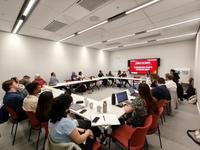
The Spatial Methodologies Student Research Network hosted the postgraduate ‘Spatial History Workshop: Spaces and Identity’ on 22 May 2026 in the Stephen A. Schwarzman Centre for the Humanities. The workshop brought together current postgraduates working spatially across time periods and geographies in the fields of history, art history, literature, and modern languages. The exchange allowed participants to discuss methodological and theoretical approaches and receive actionable feedback on their dissertations.
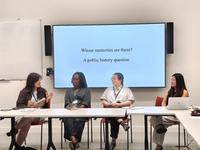
The international workshop featured nine postgraduate presenters from five UK universities (Oxford, Cambridge, Bristol, Lancaster, and Warwick) and one EU university (Central European University). It was divided into three panels centred around the themes ‘Negotiating Space in “Other” Society’, ‘Anxiety, Appearance, and Expectation’, and ‘Displacement’. Topics included the role of space in processes of community-building and inter-communal exchange in diaspora communities in 19th century Algiers, the production of space through theatrical performances in ‘oriental nightclubs’ in the mid-twentieth century United States, changing spatial practices as a source of anxiety in 17th century England and France, and more. Participants drew on an array of complementary approaches, including the study of memory, emotions, and visual and material culture, demonstrating the role of diverse factors in space’s production and social effects.
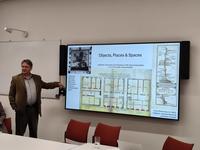
A keynote lecture titled ‘Social Sites: Reflections on Early Modern Approaches’ was delivered by Prof. Beat Kümin (Warwick). Prof. Kümin is an early modernist whose work has been instrumental in introducing the Spatial Turn to the study of central European and British early modern history. His publications include 'At home and in the workplace: A historical introduction to the spatial turn', in: History & Theory 52 (2013, co-authored with Cornelie Usborne); 'Sacred church and worldly tavern: Reassessing an early modern divide', in: Sacred Space in Early Modern Europe (ed. Will Coster & Andrew Spicer, 2005); the monograph Drinking Matters: Public Houses and Social Exchange in Early Modern Central Europe (2007); the edited collection Political Space in Pre-Industrial Europe (2009); and the textbook The European World 1500-1800: An Introduction to Early Modern History (4th ed., 2023). Drawing on this wealth of experience and a passion for teaching, Prof. Kümin’s intervention mixed theoretical depth with accessible advice for the participants. It took participants on a historiographical journey, tracking the development of spatial approaches from earlier ‘container’ or ‘backdrop’ conceptions to a relational construct produced through social interaction which is also an active social agent. Prof. Kümin’s contribution emphasised the need to utilise spatial approaches in a theoretically consistent manner while suggesting emerging frontiers in the Spatial Turn, such as environmental and post-humanist approaches.
The workshop realised the Spatial Methodologies Student Research Network’s goal of creating an informal, interdisciplinary encounter to help postgraduate participants refine their use of space as an analytical research tool. We are grateful to TORCH for its generous support of this workshop. This not only made our vision possible but provided a platform for publicising this event throughout the UK university system and beyond. We would particularly like to thank TORCH’s Julia Antal, Krisztina Lugosi, and Sarah Clay for their organisational support throughout the process. We would also like to acknowledge the generous supports of the German Historical Society and the Association for German Studies in Great Britain and Ireland. Lastly, we would like to thank Prof. Kümin for his invaluable contributions, our doctoral supervisors (Robert Evans, Giuseppe Marcocci, Lyndal Roper, and William Whyte), our postgraduate presenters (Riwan Bellour, Tina Xue, Sophia Jaffer, Georgie Walker, Angelina Andreeva, Hestia Jingyan Zhang, Jeanne Dufresne, Celine Henry-Agyemang, and Yuni Zeng), our panel chairs (Nik Groschinski, Louisa Bergold, and Anastazja Grudnicka), and the workshop’s many attendees.