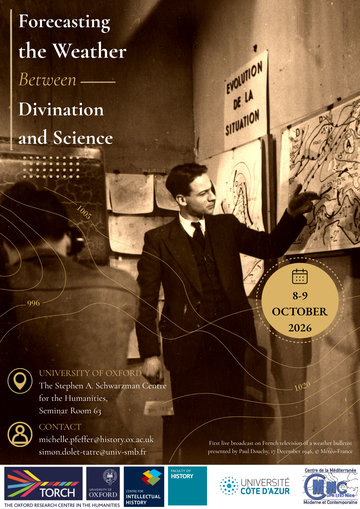
Thursday 8 October and Friday 9 October 2026, 9am - 6.30pm
Seminar Room 00.063, Schwarzman Centre for the Humanities
Grove Auditorium, Magdalen College on 8 October from 5.30pm to 6.30pm
Forecasting the weather, between divination and science (Antiquity to the present)
Organised by Michelle Pfeffer and Simon Dolet
For further information please email michelle.pfeffer@history.ox.ac.uk.
The conference will be live streamed via Teams. Please register here to receive the link.
See full program here.
This interdisciplinary conference is the first to consider the history of weather forecasting from antiquity to the present. Modern weather forecasting is often dated to 1 August 1861, when Robert FitzRoy, founding director of the Met Office, published the first short-range forecast in The Times. FitzRoy formalised the term ‘weather forecast’ to distinguish his new paradigm from millennia-old traditions of divination, but the scientific community was not convinced. Criticism of his forecasts’ many failures became so overwhelming that he took his own life. A parliamentary report concluded current atmospheric knowledge was insufficient, and the Met Office was ordered to cease daily forecasts.
This episode points to issues of expertise, legitimacy, and scepticism that surround weather prediction. Across history, societies developed diverse methods to anticipate meteorological hazards, from ancient ‘weather signs’, extispicy, geomancy, and astrology to meteorological cycles, synoptic meteorology, and numerical prediction. Competing approaches generated debate over the limits of human knowledge, leading to recurring crises of legitimacy.
The history of weather forecasting has recently begun to flourish, but most studies begin in the nineteenth century, ignoring or dismissing a vast history of alternative approaches. This conference will break new ground by (1) drawing attention to predictive methods beyond those more recognisable to modern eyes, and (2) broadening the chronological and geographical focus to identify shared dynamics, continuities, and transformations. We are particularly interested in the fact many practices now dismissed as superstitious relied on observation, record-keeping, and comparative analysis; scientific forecasting developed in dialogue with these rather than simply replacing them.
Divination, Oracles, and Omens Network