Theatre & Performance: HT '26 round-up
What has happened across theatre & performance during Hilary Term 2026?
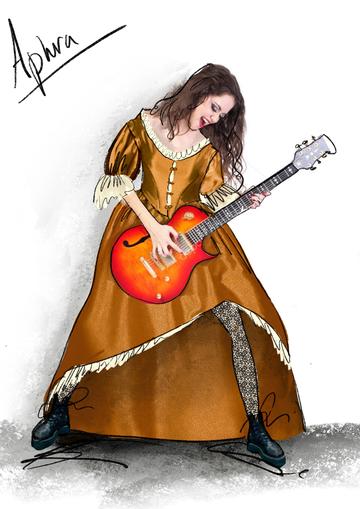
Spotlight: Restoration Comedy for the 21st Century: Adapting Aphra Behn's Rover
The project led by Professor David Taylor (English) went into a two-week period of rehearsal and development with theatre company The Thelmas.
"Perhaps the most reassuring aspect of the experience was the productive working relationship fostered between the creative and academic teams. Rehearsal rooms do not always facilitate such an easy relationship. It is inevitable that researchers and creatives will not always see eye-to-eye due to differences in our training, processes, and priorities. Unfortunately, it is all too easy for researchers’ respect for the original text to be dismissed as purist, and a production team’s irreverent creative vision to be mistaken for contempt for the play as written. Yet on this project, the teams’ differing skills worked harmoniously to create a piece of contemporary entertainment which remained faithful to the spirit of Behn’s play. Both the production team’s aims and the academics’ research questions were ultimately served well by the collaboration. It was gratifying to hear from actors and creatives how much they had valued our presence in the rehearsal room as facilitators of creativity." Click here to read the blog post.
Activity
The final event in our series of Trans & Queer Voices In Performance Research study days took place, a workshop with Donna Marcus Duke of publishing initiative TISSUE. We are so proud of this series, which brought artists and researchers together to explore an exciting space. We're looking ahead to our next series on Performance and Migration, which will take place in MT '26.
We launched Performance Pathway, a collaboration between the Performance Research Hub and the Cultural Programme (the producing team behind the performance programme at the Schwarzman Centre for the Humanities) which aims to provide students and interested staff with the skills, knowledge and confidence to enter the performing arts sector. Our first event was a Careers in Producing panel with three CP producers - click here to read the notes. Coming up in TT '26, the team will give an introduction to events budgeting.
Professor Dan Rebellato (Royal Holloway) visited to present his hugely important report British Theatre Before & After Covid. He was hosted by Professors Sos Eltis and Kirsten Shepherd (English). Click here to watch a recording of the event.
The Hub's student committee launched a new series: Write, Meet & Talk (or not!) to support students working in performance research, and held their first work-in-progress sharing session. Hub-supported event Beyond Borders: Ukrainian Voices in Performance brought three Ukrainian artists together to discuss theatre-making. We enjoyed three events organised by our fellow TORCH Research Hub, Medical Humanities: a presentation on music and the medical humanities, a roundtable on using theatre to contribute to conversations on predictive genomics, and a talk about the 'theatre' of medicine.
We're delighted to say that the participatory event small grants are open again, with the deadline of 27 April!
RSC Interdisciplinary Fellows 2024-25
RSC IF
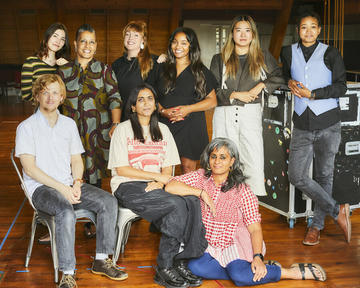
The Royal Shakespeare Company's Interdisciplinary Fellowships scheme continued, with our second two fellows starting this year. Taio Lawson spent a week in Oxford meeting researchers across theatre, A.I. and digital scholarship, building up to his project on using A.I. as a collaborator in theatre. Matilda Feyiṣayọ Ibini will join us in Trinity Term.
We said goodbye to our previous two fellows:
Stephen Bailey: Creative Approaches to Translating the Classics. "Translated drama has long shaped British theatre, yet certain traditions — notably Spain’s Golden Age — remain marginal despite their historical and artistic significance. My research examined how prevailing industry approaches to translation, particularly the pursuit of ‘accuracy’, may limit how classical texts are understood, valued, and staged today." Click here to read the full case study.
Amahra Spence: Spatial Dramaturgy - Cities, Space and Design as Performance. "My fellowship led me to think about spatial dramaturgy as a critical framework through which theatre-making and performance practice entangle with the design of built environments. Drawing on Black feminist thought, decolonial spatial theory, and performance studies, I’m interested in the ways that space is not a neutral container but a script: one that directs movement, distributes visibility, organises relation and encodes power. Theatre-makers, long attuned to the politics of staging, blocking and audience configuration, possess methodologies that can productively intervene in architectural and urban design practices. By reading space as dramaturgical structure, we shift from designing objects to designing relations. Through this reframing, spatial practice becomes accountable to questions of embodiment, surveillance, repair, and collective imagination." Click here to read the full case study.